Shop
 Grade workbooks


Classroom · Science · Matter · 1st to 3rd grade

Solids, liquids and gases worksheets
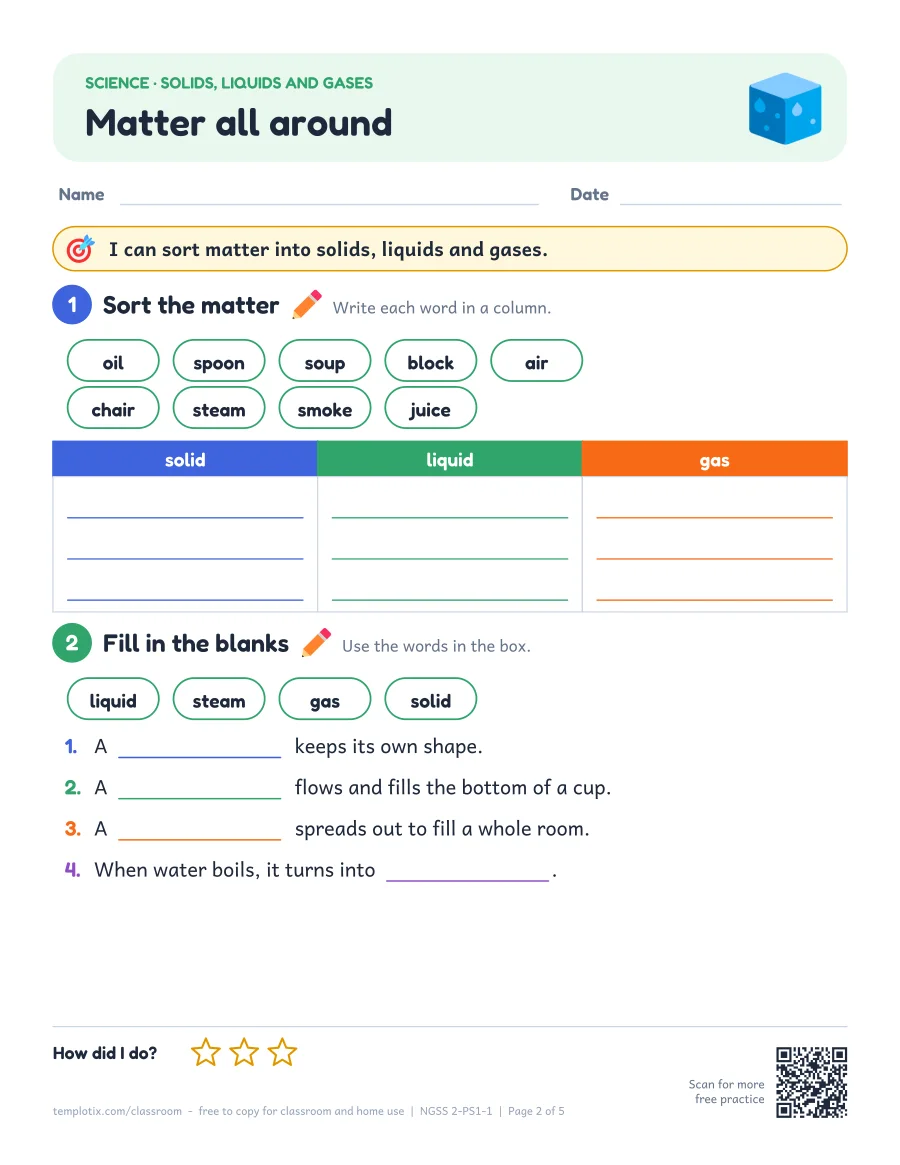
A free five-page science pack for 1st to 3rd grade: learn to sort things into solids, liquids and gases, with a labeled picture, practice pages, a hands-on experiment and an answer key.
The big idea
 The big idea
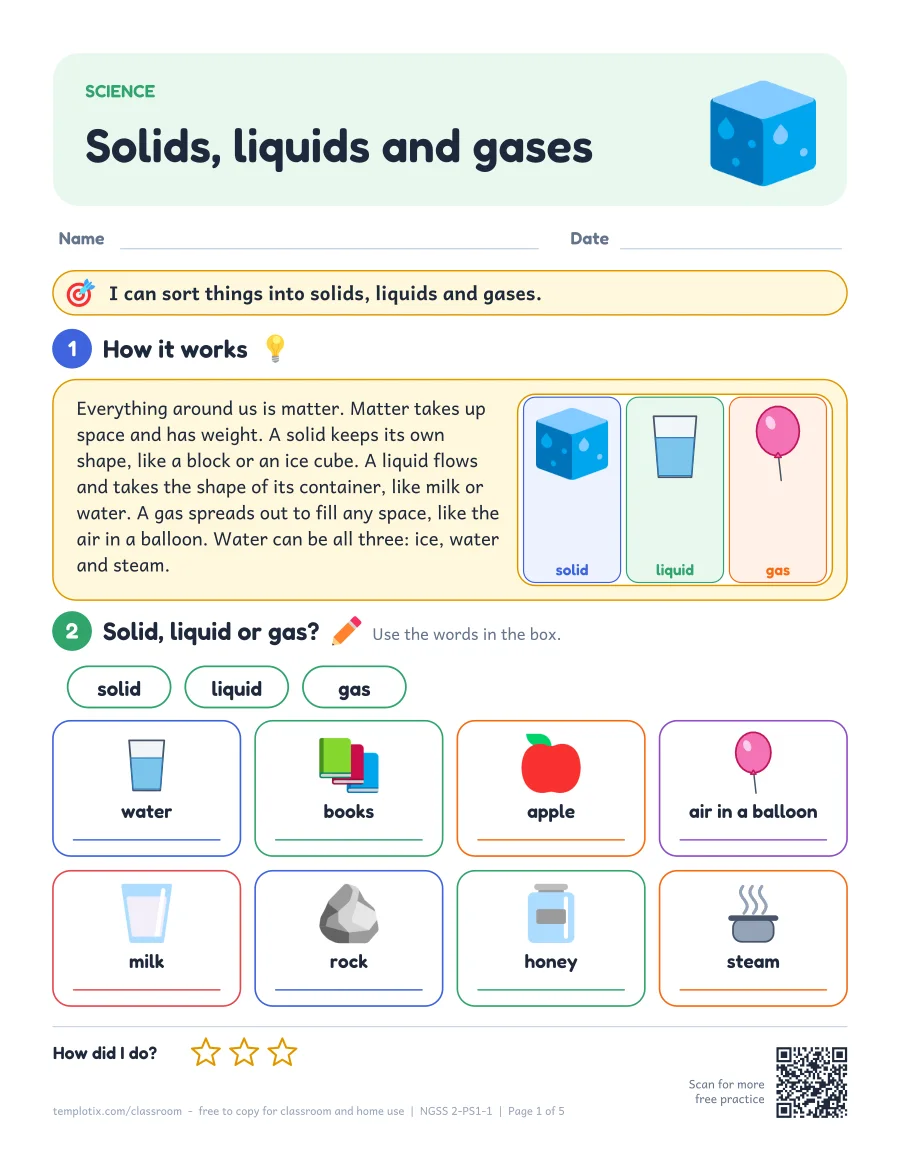
Everything around us is matter. Matter takes up space and has weight. A solid keeps its own shape, like a block or an ice cube. A liquid flows and takes the shape of its container, like milk or water. A gas spreads out to fill any space, like the air in a balloon. Water can be all three: ice, water and steam.
Teaching tip
 Teaching tip
Hold up a block, a cup of water and a blown-up balloon. Let children push, pour and squeeze each one, then decide which group it belongs in and say how they know.
Try it: solid, liquid or gas?
 Try it: solid, liquid or gas?
I can test the shape of a solid, a liquid and a gas.
You need
- An ice cube on a plate
- A cup of water
- A clear plastic bottle
- A balloon
- A grown-up
What to do
- 1Look at the ice cube on the plate. Does it keep its own shape?
- 2Pour the water into the bottle, then back into the cup. What shape is it now?
- 3A grown-up blows up the balloon. What fills it?
- 4Let the air out slowly near your hand. Can you feel the gas?
Predict first: Which one keeps its own shape: the ice, the water or the air?What happens?
The ice keeps its own shape, so it is a solid. The water changes shape to fit the bottle and then the cup, so it is a liquid. The air spreads out to fill the whole balloon, and you can feel it rush out, so it is a gas. All three are matter: they take up space.
Safety: a grown-up blows up the balloon. Broken balloons can make children choke, so throw away any pieces at once.
Quick check
What is matter?Tap to checkAnything that takes up space and has weight
Does a solid keep its own shape?Tap to checkYes
What does a liquid do?Tap to checkIt flows and takes the shape of its container
What does a gas do?Tap to checkIt spreads out to fill any space
Is milk a solid, a liquid or a gas?Tap to checkA liquid
What is water called when it is a gas?Tap to checkSteam, or water vapor
What the worksheets look like
States of matter poster
 States of matter poster
One colorful page showing solids, liquids and gases, how their tiny particles are packed, and everyday examples of each. Made for a science wall.
Common questions
What are the three states of matter?
Solid, liquid and gas. A solid keeps its shape, a liquid takes the shape of its container, and a gas spreads out to fill any space. Water is the easiest example: ice, water and steam.
Is air matter?
Yes. Air takes up space and has weight, even though we cannot see it. Blow up a balloon to show air taking up space, or push an upside-down cup into water and watch the air keep the water out.
What grade learns solids, liquids and gases?
Usually 1st to 3rd grade. In the Next Generation Science Standards (NGSS) it supports 2-PS1-1.
Is there a hands-on experiment?
Yes. Page 4 is a Try it! experiment, solid, liquid or gas?, with a materials list, a prediction and an observation chart. Safety: a grown-up blows up the balloon. Broken balloons can make children choke, so throw away any pieces at once.
Is there an answer key?
Yes. Page 5 has every answer from the pack, what to expect from the experiment and a short teaching tip.