Shop
 Grade workbooks


Classroom · Science · Earth's surface · 2nd grade

Fast and slow Earth changes worksheets
A free five-page science pack for 2nd grade: learn to tell if a change to Earth is fast or slow, with a labeled picture, practice pages, a hands-on experiment and an answer key.
The big idea
 The big idea
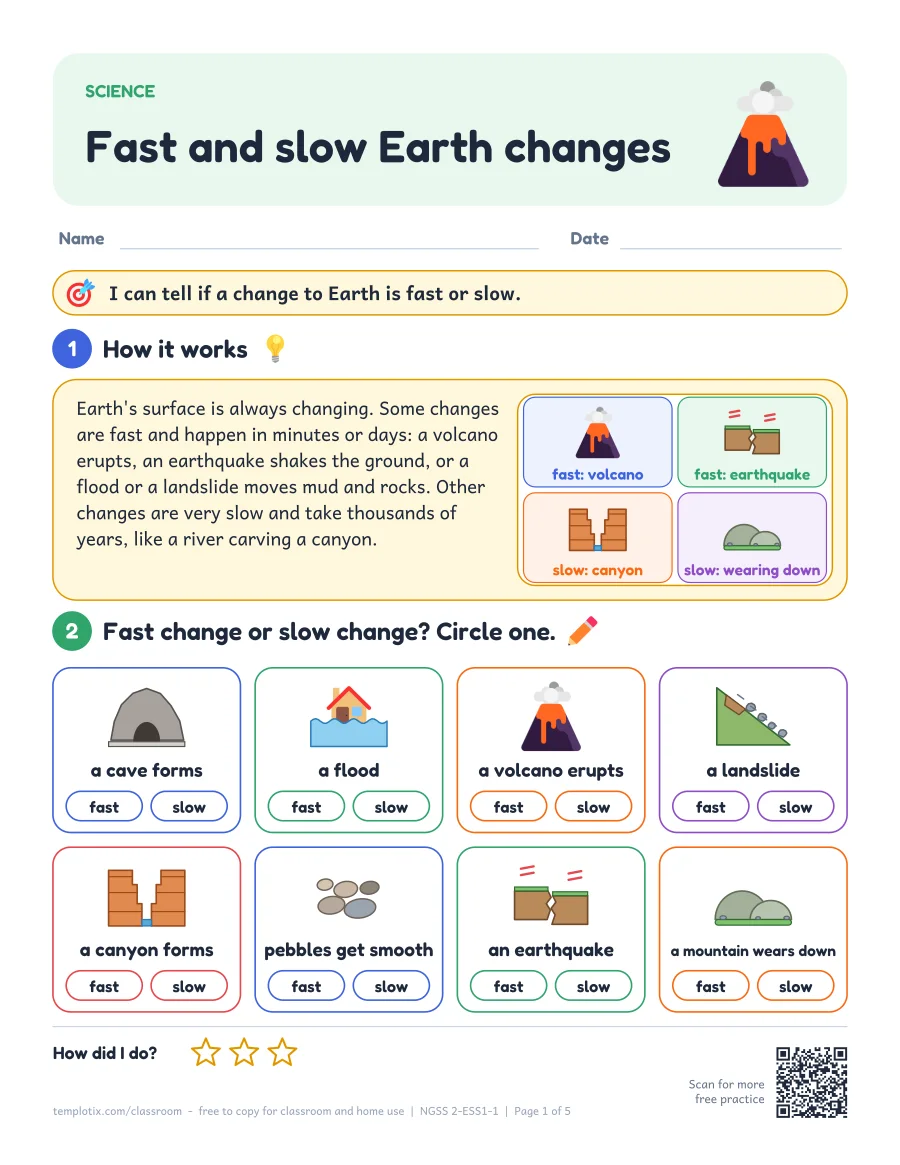
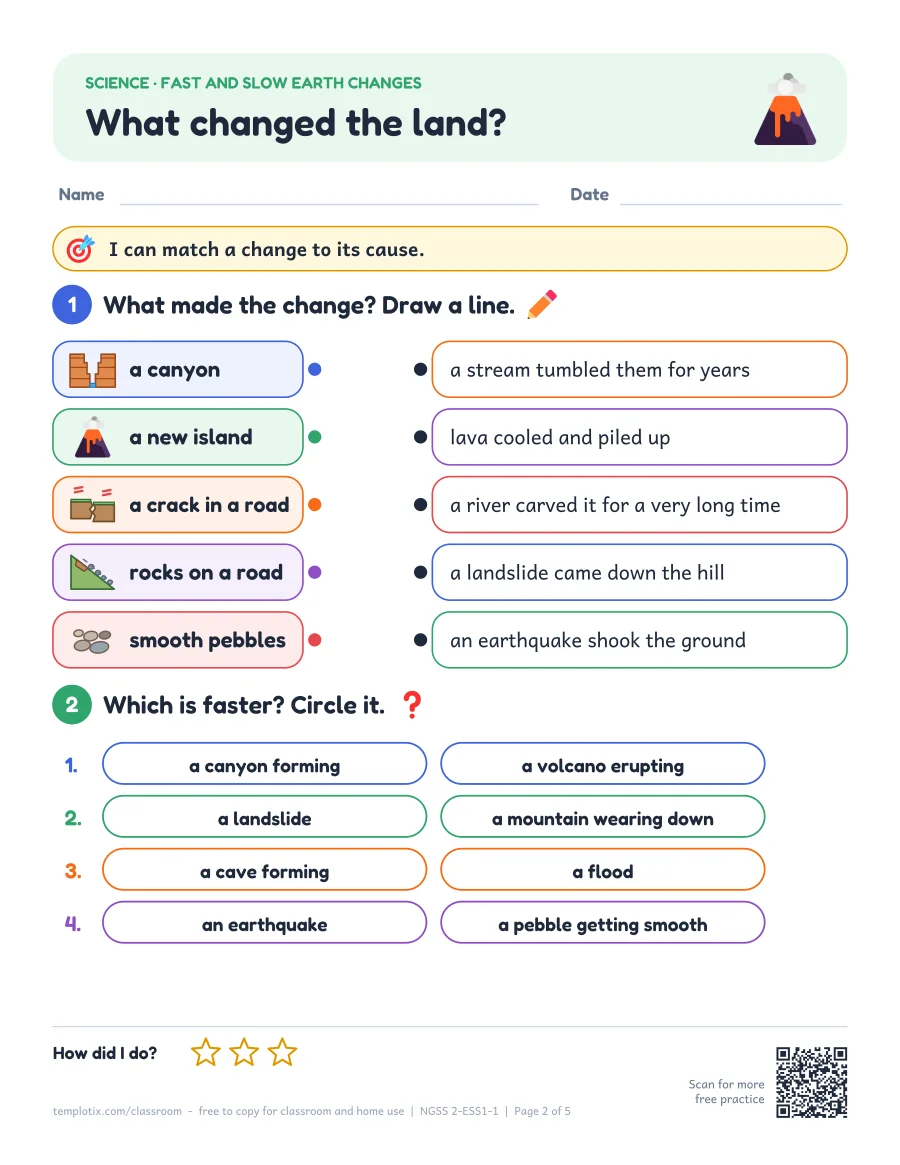
Earth's surface is always changing. Some changes are fast and happen in minutes or days: a volcano erupts, an earthquake shakes the ground, or a flood or a landslide moves mud and rocks. Other changes are very slow and take thousands of years, like a river carving a canyon.
Teaching tip
 Teaching tip
Make a class timeline with two ends: one second and one million years. Let children place each change on it with a sticky note.
Try it: flood or drip?
 Try it: flood or drip?
I can compare a fast change and a slow change.
You need
- A tray
- Damp sand
- A cup of water
- A spoon
- A towel
What to do
- 1Build two hills of damp sand on the tray, the same size.
- 2Pour the whole cup of water on hill 1 all at once. This is a flood.
- 3Fill the cup again. Drip it on hill 2 one spoonful at a time for 3 minutes.
- 4Draw both hills. How did each one change?
Predict first: Which hill will change more?What happens?
The flood quickly cuts a big gully in hill 1 or washes much of it away: a fast change. Hill 2 changes a little at a time as small channels carve into it. Real slow changes take thousands of years, but the drips show how small changes add up.
Safety: work outside or on a tray, keep sand away from eyes and wash hands after.
Quick check
Name 2 fast changes to the land.Tap to checkA volcano, an earthquake, a landslide or a flood
Name 2 slow changes to the land.Tap to checkA canyon forming, a mountain wearing down or pebbles getting smooth
How long does a canyon take to form?Tap to checkA very long time, thousands of years
What does an earthquake do?Tap to checkIt shakes the ground
What should you do in an earthquake?Tap to checkDrop, cover and hold on
Can a volcano make new land?Tap to checkYes, lava cools into new rock
What the worksheets look like
Landforms poster
 Landforms poster
One colorful page with eight kinds of land and water (mountain, hill, valley, plain, island, river, lake and ocean), each with a picture and a one-line meaning. Made for a science wall.
Common questions
What are examples of fast changes to Earth?
Volcanic eruptions, earthquakes, landslides and floods. They change the land in minutes, hours or days.
What are examples of slow changes to Earth?
Weathering, erosion and the rising of mountains take thousands or millions of years. The Grand Canyon formed as the Colorado River cut through rock over millions of years.
What grade learns fast and slow earth changes?
Usually 2nd grade. In the Next Generation Science Standards (NGSS) it supports 2-ESS1-1.
Is there a hands-on experiment?
Yes. Page 4 is a Try it! experiment, flood or drip?, with a materials list, a prediction and an observation chart. Safety: work outside or on a tray, keep sand away from eyes and wash hands after.
Is there an answer key?
Yes. Page 5 has every answer from the pack, what to expect from the experiment and a short teaching tip.