Shop
 Grade workbooks


Classroom · Science · Weather · 2nd and 3rd grade
Weather tools worksheets
A free five-page science pack for 2nd and 3rd grade: learn to name weather tools and tell what each one measures, with a labeled picture, practice pages, a hands-on experiment and an answer key.
The big idea
 The big idea
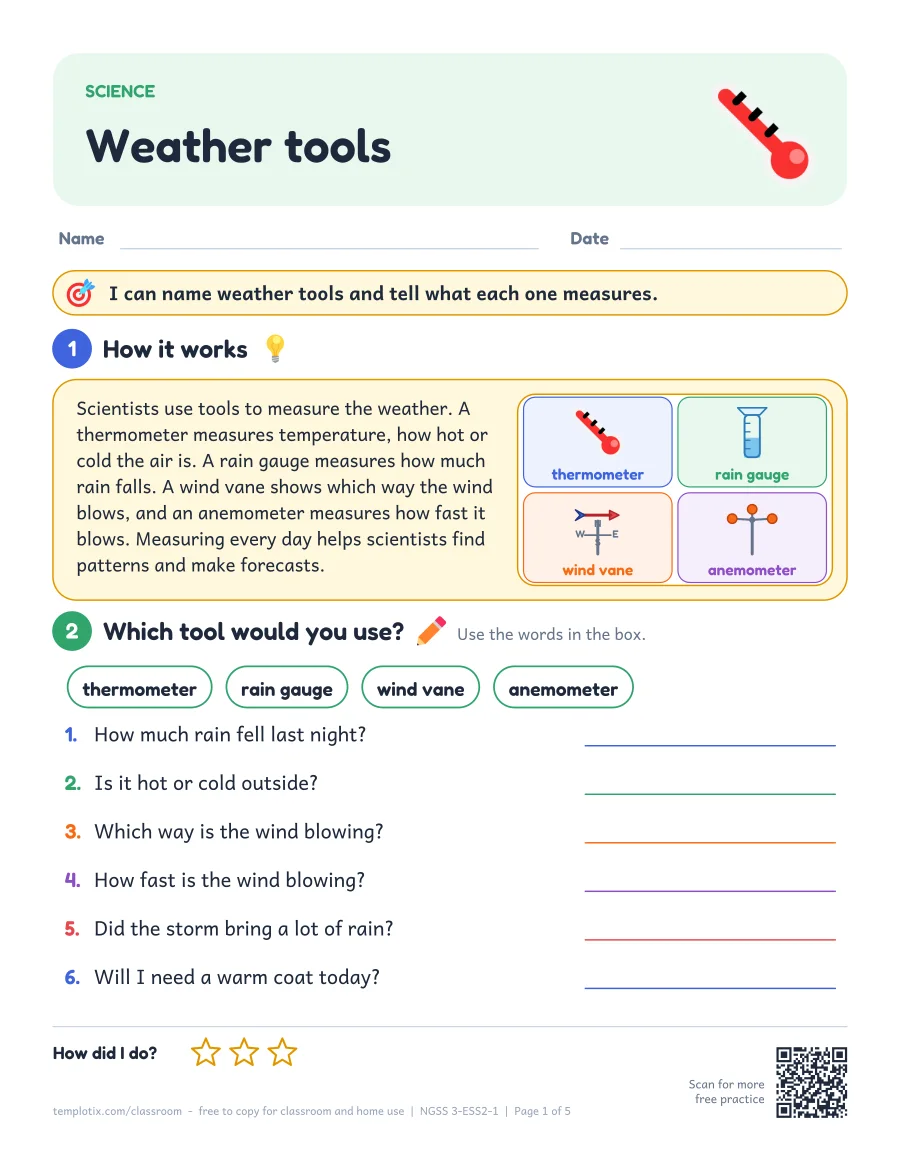
Scientists use tools to measure the weather. A thermometer measures temperature, how hot or cold the air is. A rain gauge measures how much rain falls. A wind vane shows which way the wind blows, and an anemometer measures how fast it blows. Measuring every day helps scientists find patterns and make forecasts.
Teaching tip
 Teaching tip
Hang a big paper thermometer in class and move a red ribbon to the temperature each morning. Children quickly link numbers like 30 and 80 to how the air feels outside.
Try it: make a rain gauge
 Try it: make a rain gauge
I can build a tool to measure rain.
You need
- A clear plastic bottle
- Scissors, for a grown-up
- A ruler
- Tape
- A few small stones
What to do
- 1A grown-up cuts the top off the bottle and sets it in upside down, like a funnel.
- 2Put the stones in the bottom. Add water to cover them: this water line is zero.
- 3Tape the ruler to the side, with 0 at the water line.
- 4Set it in an open place outside. Read it at the same time each day, then pour out the extra.
Predict first: How much rain will fall in 3 days?What happens?
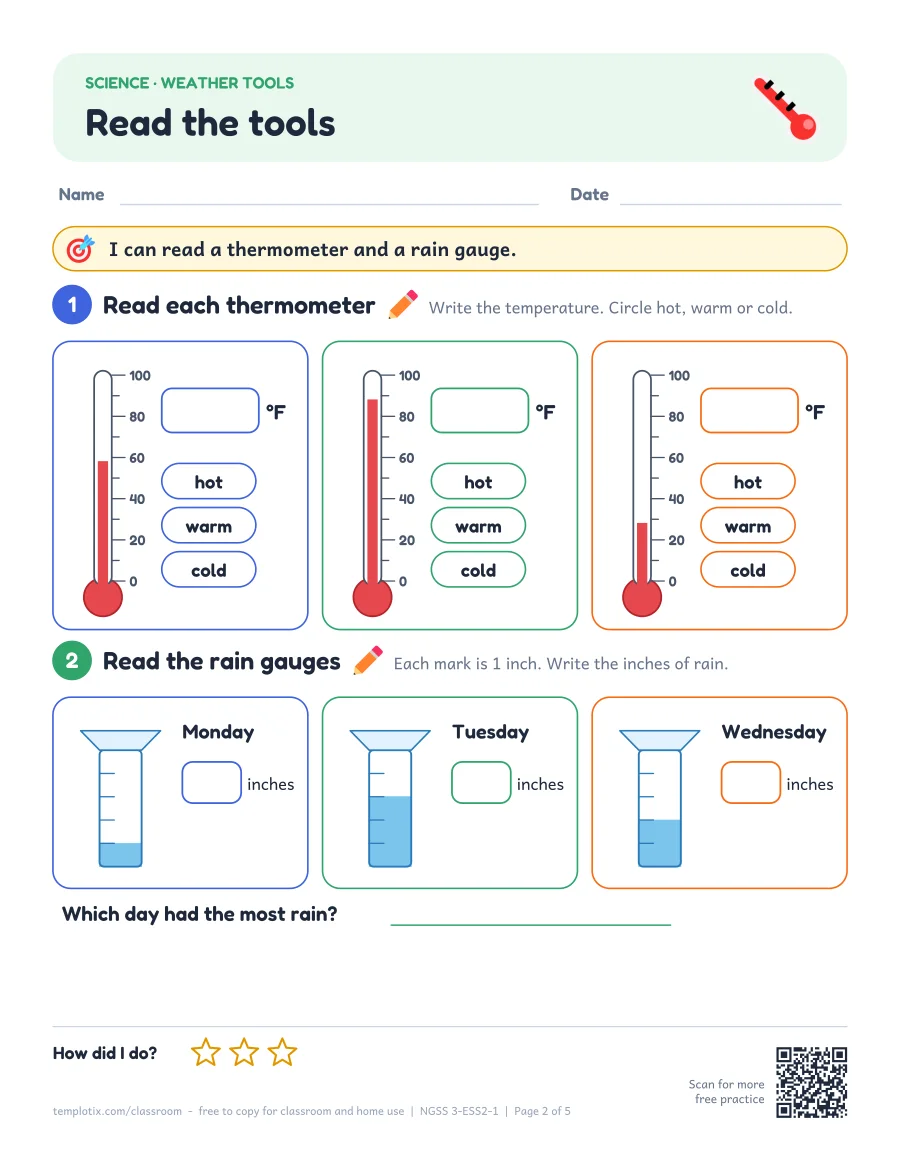
Answers will vary with the weather. A light rain may add less than a quarter of an inch, and a big storm can add an inch or more. Reading the gauge at the same time each day and adding up the days is just what weather scientists do.
Safety: a grown-up does the cutting, because cut plastic can be sharp. Do not check the gauge during a thunderstorm.
Quick check
What does a thermometer measure?Tap to checkTemperature, how hot or cold the air is
What does a rain gauge measure?Tap to checkHow much rain falls
What does a wind vane show?Tap to checkWhich way the wind blows
What does an anemometer measure?Tap to checkHow fast the wind blows
Why do scientists measure the weather?Tap to checkTo find patterns and make forecasts
Is 90 degrees Fahrenheit hot or cold?Tap to checkHot
What the worksheets look like
Water cycle poster
 Water cycle poster
One colorful page with a labeled water cycle picture and the four steps: evaporation, condensation, precipitation and collection. Made for a science wall.
Common questions
What tool measures wind?
A wind vane shows which way the wind is blowing, and an anemometer measures how fast it blows. A windsock shows both in a rough way, which is why airports use them.
Can kids make their own weather tools?
Yes. A straight-sided jar with a ruler taped to it works as a rain gauge, and a pinwheel shows how hard the wind is blowing. An outdoor thermometer is the one tool worth buying.
What grade learns weather tools?
Usually 2nd and 3rd grade. In the Next Generation Science Standards (NGSS) it supports 3-ESS2-1.
Is there a hands-on experiment?
Yes. Page 4 is a Try it! experiment, make a rain gauge, with a materials list, a prediction and an observation chart. Safety: a grown-up does the cutting, because cut plastic can be sharp. Do not check the gauge during a thunderstorm.
Is there an answer key?
Yes. Page 5 has every answer from the pack, what to expect from the experiment and a short teaching tip.