Shop
 Grade workbooks


Classroom · Science · Earth's surface · 1st and 2nd grade
All about rocks worksheets
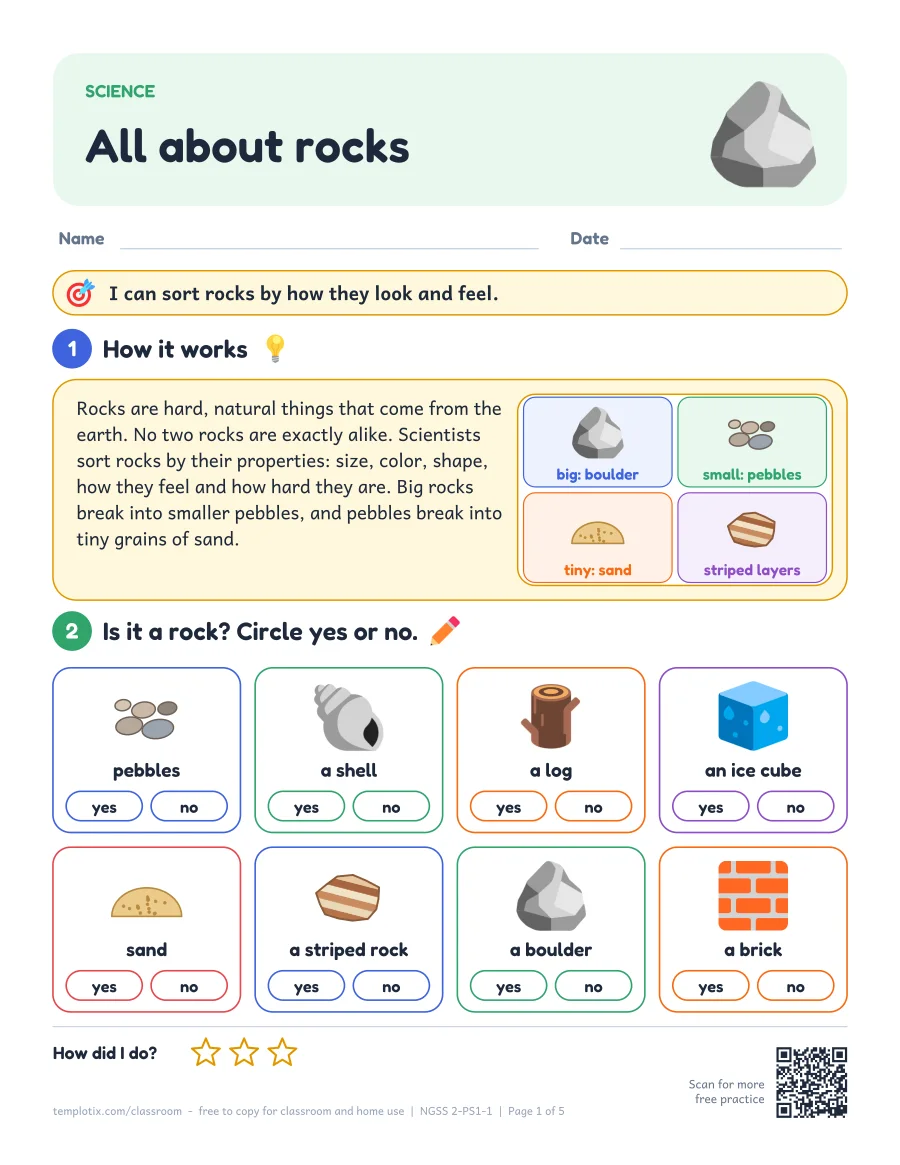
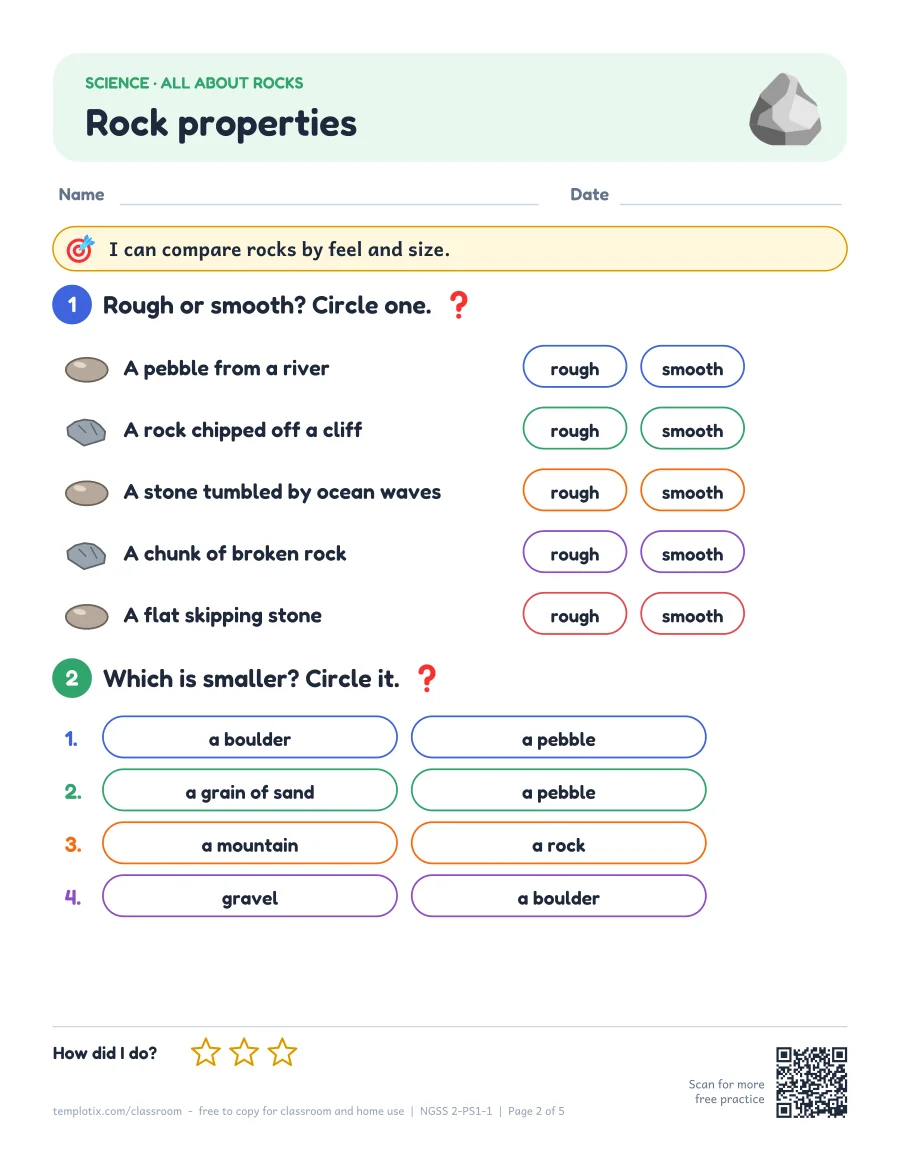
A free five-page science pack for 1st and 2nd grade: learn to sort rocks by how they look and feel, with a labeled picture, practice pages, a hands-on experiment and an answer key.
The big idea
 The big idea
Rocks are hard, natural things that come from the earth. No two rocks are exactly alike. Scientists sort rocks by their properties: size, color, shape, how they feel and how hard they are. Big rocks break into smaller pebbles, and pebbles break into tiny grains of sand.
Teaching tip
 Teaching tip
Give each child one rock to study for the whole lesson. Ask them to describe it so well that a friend could pick it out of the pile.
Try it: rock detective
 Try it: rock detective
I can describe rocks by their properties.
You need
- 4 different rocks
- A magnifier
- A cup of water
- A metal spoon
- Crayons
What to do
- 1Look at each rock with the magnifier. What colors and specks do you see?
- 2Feel each rock. Is it rough or smooth?
- 3Dip each rock in the water. Does it look different when wet?
- 4Try to scratch each rock with the spoon. Does it leave a mark?
Predict first: Which rock do you think is the hardest?What happens?
Answers will vary with the rocks. Most rocks look darker and show brighter colors and patterns when they are wet. Hard rocks do not scratch, while soft rocks, like chalk or sandstone, may show a scratch or rub off grains. The hardest rock is the one the spoon cannot mark.
Safety: never throw rocks, keep small pebbles away from mouths and wash hands after.
Quick check
What are rocks made of?Tap to checkNatural, hard material from the earth
Which is bigger, a pebble or a boulder?Tap to checkA boulder
What is sand made of?Tap to checkTiny bits of rock
Name 3 ways to sort rocks.Tap to checkSize, color, shape, feel or hardness
What makes river pebbles smooth?Tap to checkMoving water rubs them
Is a shell a rock?Tap to checkNo, an animal made it
What the worksheets look like
Landforms poster
 Landforms poster
One colorful page with eight kinds of land and water (mountain, hill, valley, plain, island, river, lake and ocean), each with a picture and a one-line meaning. Made for a science wall.
Common questions
What are the three types of rocks?
Igneous rocks form from cooled lava or magma, like granite and pumice. Sedimentary rocks form from layers of sand and mud pressed together, like sandstone. Metamorphic rocks are rocks changed by heat and pressure, like marble.
How can kids start a rock collection?
Collect small rocks from a yard, park or beach where collecting is allowed. Wash them, sort them by color, size and texture, and label each one with where it was found. An egg carton makes a good display box.
What grade learns all about rocks?
Usually 1st and 2nd grade. In the Next Generation Science Standards (NGSS) it supports 2-PS1-1.
Is there a hands-on experiment?
Yes. Page 4 is a Try it! experiment, rock detective, with a materials list, a prediction and an observation chart. Safety: never throw rocks, keep small pebbles away from mouths and wash hands after.
Is there an answer key?
Yes. Page 5 has every answer from the pack, what to expect from the experiment and a short teaching tip.