Shop
 Grade workbooks


Classroom · Math · CCSS 3.NBT.A.1, 4.NBT.A.3, 3.OA.D.8
worksheets for 3rd and 4th grade
Round whole numbers to the nearest 10, 100 and 1,000, then use rounding to estimate sums and differences. Children read number lines, use the digit next door, find the smallest and largest numbers that round to a value, and check answers with an estimate.
- Rounding to the nearest 103rd grade
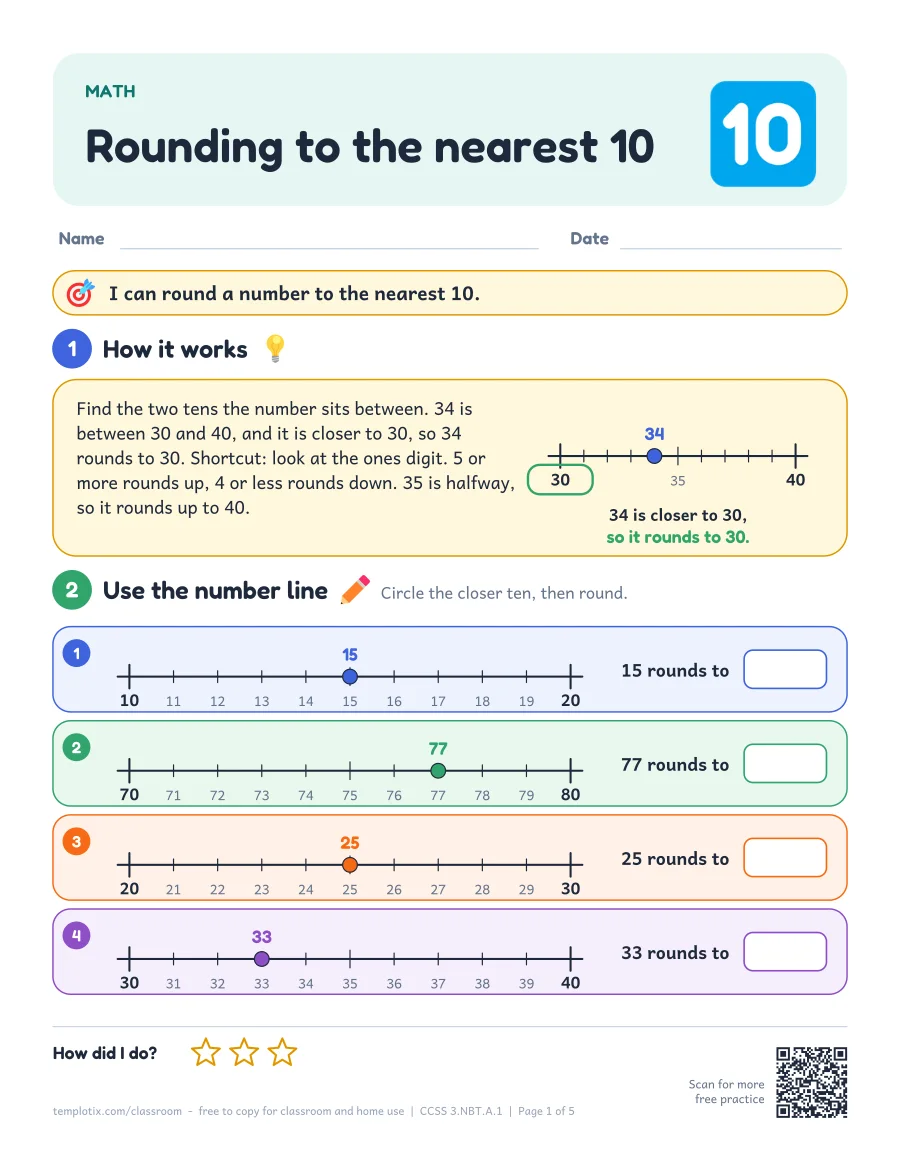
Find the two tens the number sits between. 34 is between 30 and 40, and it is closer to 30, so 34 rounds to 30. Shortcut: look at the ones digit. 5 or more rounds up, 4 or less rounds down. 35 is halfway, so it rounds up to 40.
- Rounding to the nearest 1003rd grade
Find the two hundreds the number sits between. 270 is between 200 and 300, and it is closer to 300, so 270 rounds to 300. Shortcut: look at the tens digit. 5 or more rounds up, 4 or less rounds down. 250 is halfway, so it rounds up.
- Rounding to the nearest 1,0004th grade
Find the two thousands the number sits between. 4,600 is between 4,000 and 5,000, and it is closer to 5,000, so it rounds to 5,000. Shortcut: look at the hundreds digit. 5 or more rounds up, 4 or less rounds down.
- Estimating sums and differences3rd grade
Round each number first, then add or subtract the rounded numbers. 48 + 31 is about 50 + 30 = 80. An estimate is a quick, close answer. Use it to check: if an exact answer is far from the estimate, look again.




Rounding poster
 Rounding poster
A one-page anchor chart with the number line, the digit rule and estimating.
Whole unit in one PDF Plus
 Whole unit in one PDF
All rounding and estimating packs, the unit chart and a contents page: 22 pages, ready to print. For Templotix Plus members.
What is in each pack
- 1. Learn itA number line shows which ten, hundred or thousand is closer.
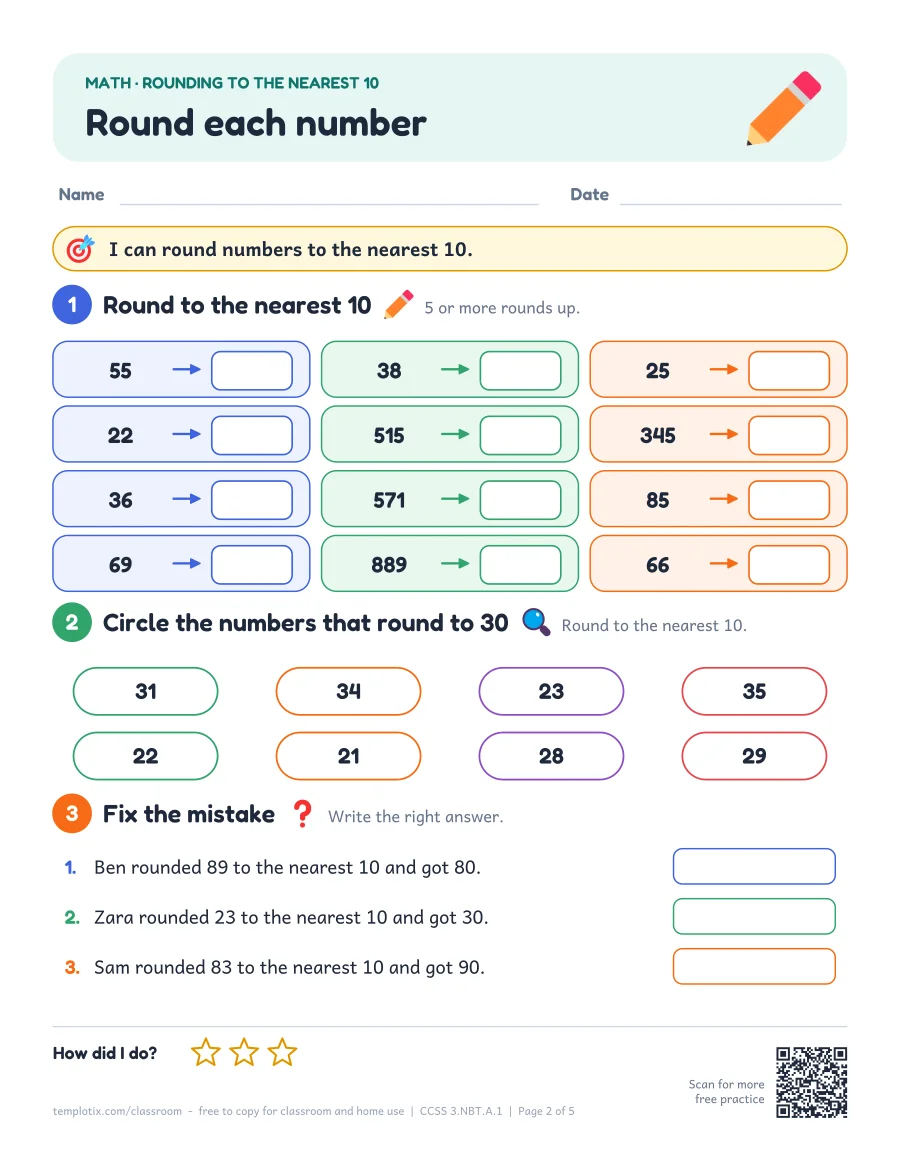
- 2. PracticeRound twelve numbers, circle the matches and fix the mistakes.
- 3. Think deeperRound two ways, find the smallest and largest, use number cards.
- 4. Word problemsFour short stories about books, buses, cookies and trips.
- 5. Answer key and tipEvery answer on one page, plus a teaching tip for grown-ups.


How to teach rounding and estimating
- Start with a number line. Ask which ten the number is closer to before teaching any rule.
- Then look next door. Underline the place you round to and check the digit to its right.
- Talk about halfway. Numbers exactly in the middle, like 45 or 650, round up.
- Use it to check. Estimate before adding or subtracting, then see if the exact answer is close.
More math
- Telling time
- Money
- Fractions
- Division
- Multi-digit multiplication
- Decimals
- Greater than and less than
- Skip counting
- Shapes
- Number bonds
- Graphs and data
- Measurement
- Area and Perimeter
- 3-Digit Addition and Subtraction
- Factors and Multiples
- Fraction Operations
- Decimal Operations
- Math Word Problems
- Geometry
- Order of Operations
- Measurement Conversions
- Counting
- Patterns
- Multiplication Strategies
- Multi-Digit Place Value
Common questions
How do you teach rounding to kids?
Start with a number line. Show the two tens (or hundreds) a number sits between and ask which one it is closer to. Once that makes sense, teach the shortcut: look at the digit to the right of the place you round to. 5 or more rounds up, 4 or less rounds down.
What grade learns rounding?
Rounding to the nearest 10 and 100 is a 3rd grade standard (CCSS 3.NBT.A.1). In 4th grade, children round multi-digit numbers to any place, such as the nearest 1,000 (CCSS 4.NBT.A.3). Estimating with rounded numbers starts in 3rd grade.
What happens when a number is exactly halfway?
A number exactly halfway, like 35 or 250, rounds up. So 35 rounds to 40 and 250 rounds to 300 when rounding to the nearest ten or hundred.
Can I copy these worksheets for my class?
Yes. The PDFs are free to print and photocopy for classroom and home use, in color or in the black-and-white ink saver. Please link to this page rather than re-uploading the files.