Shop
 Grade workbooks


Classroom · Science · Earth's surface · 2nd to 4th grade
Weathering and erosion worksheets
A free five-page science pack for 2nd to 4th grade: learn to explain how water, wind and ice change the land, with a labeled picture, practice pages, a hands-on experiment and an answer key.
The big idea
 The big idea
Weathering breaks rock into smaller pieces. Erosion carries the pieces away. Water, wind and ice are the big movers: rivers carve valleys, waves wear down cliffs, wind blows sand and glaciers scrape the land. It is usually slow, and plants, walls and fences can slow it down even more.
Teaching tip
 Teaching tip
After a rainy day, walk the school grounds and look for erosion: bare dirt, little channels, mud on paths. Then look for what stopped it, like grass and mulch.
Try it: the rain hill test
 Try it: the rain hill test
I can test how plants slow erosion.
You need
- 2 baking pans
- Damp soil
- Grass or leaves
- A paper cup with holes
- A book
What to do
- 1Fill both pans with damp soil. Press grass or a layer of leaves on top of one pan.
- 2Prop one end of each pan on the book to make a hill.
- 3Hold the cup over the top of each hill and pour in the same amount of water.
- 4Look at the water that runs off each pan. Which is muddier?
Predict first: Which hill will lose more soil?What happens?
The bare hill loses much more soil: its water runs off brown and muddy, and little channels form. The pan with grass or leaves loses much less, and its water runs clearer, because the plants hold the soil and slow the water. That is why people plant grass on hillsides.
Safety: a grown-up pokes the holes in the cup. Work outside or on a tray, and wash hands after.
Quick check
What is weathering?Tap to checkRock breaking into smaller pieces
What is erosion?Tap to checkWater, wind or ice carrying rock and soil away
Name 3 things that cause erosion.Tap to checkWater, wind and ice
How do plants slow erosion?Tap to checkTheir roots hold the soil
How was a canyon made?Tap to checkA river carved it over a very long time
How can ice split a rock?Tap to checkWater freezes in a crack and grows
What the worksheets look like
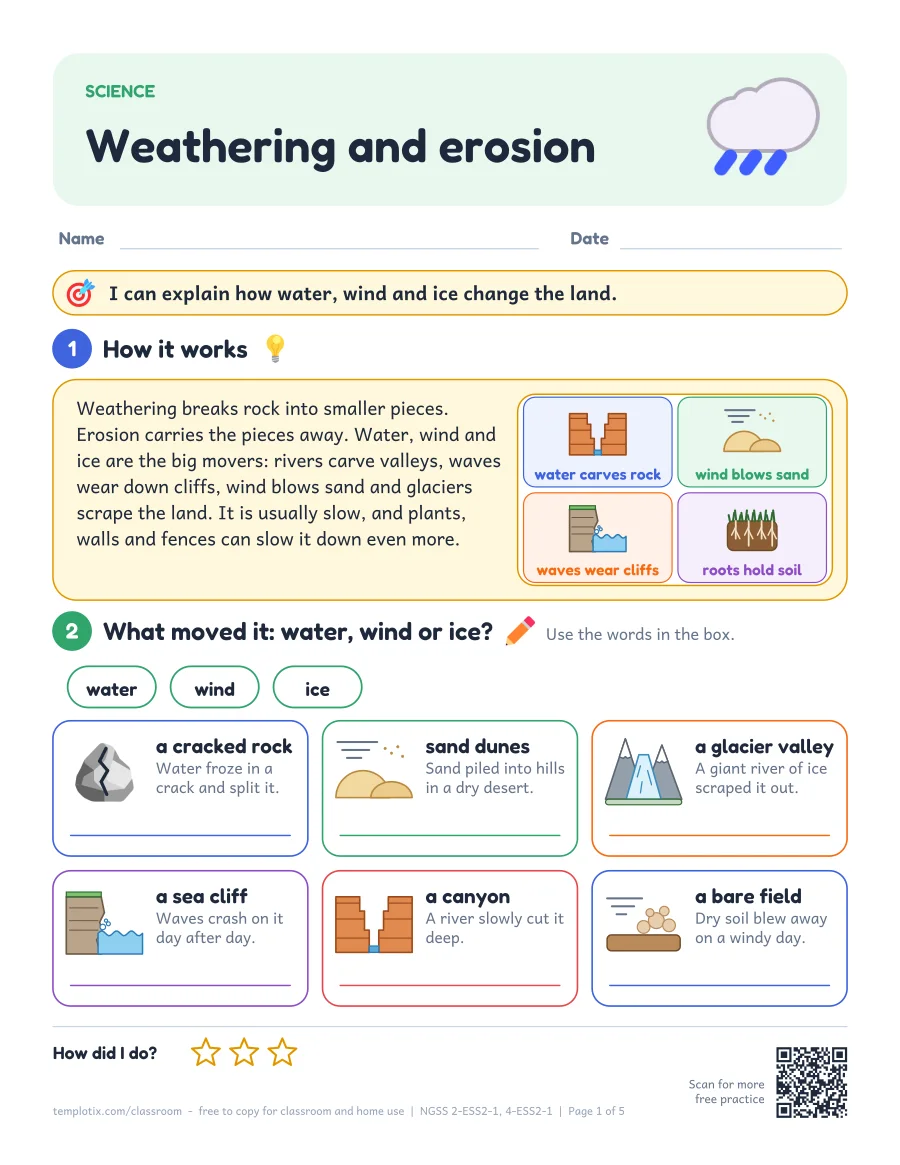
Landforms poster
 Landforms poster
One colorful page with eight kinds of land and water (mountain, hill, valley, plain, island, river, lake and ocean), each with a picture and a one-line meaning. Made for a science wall.
Common questions
What is the difference between weathering and erosion?
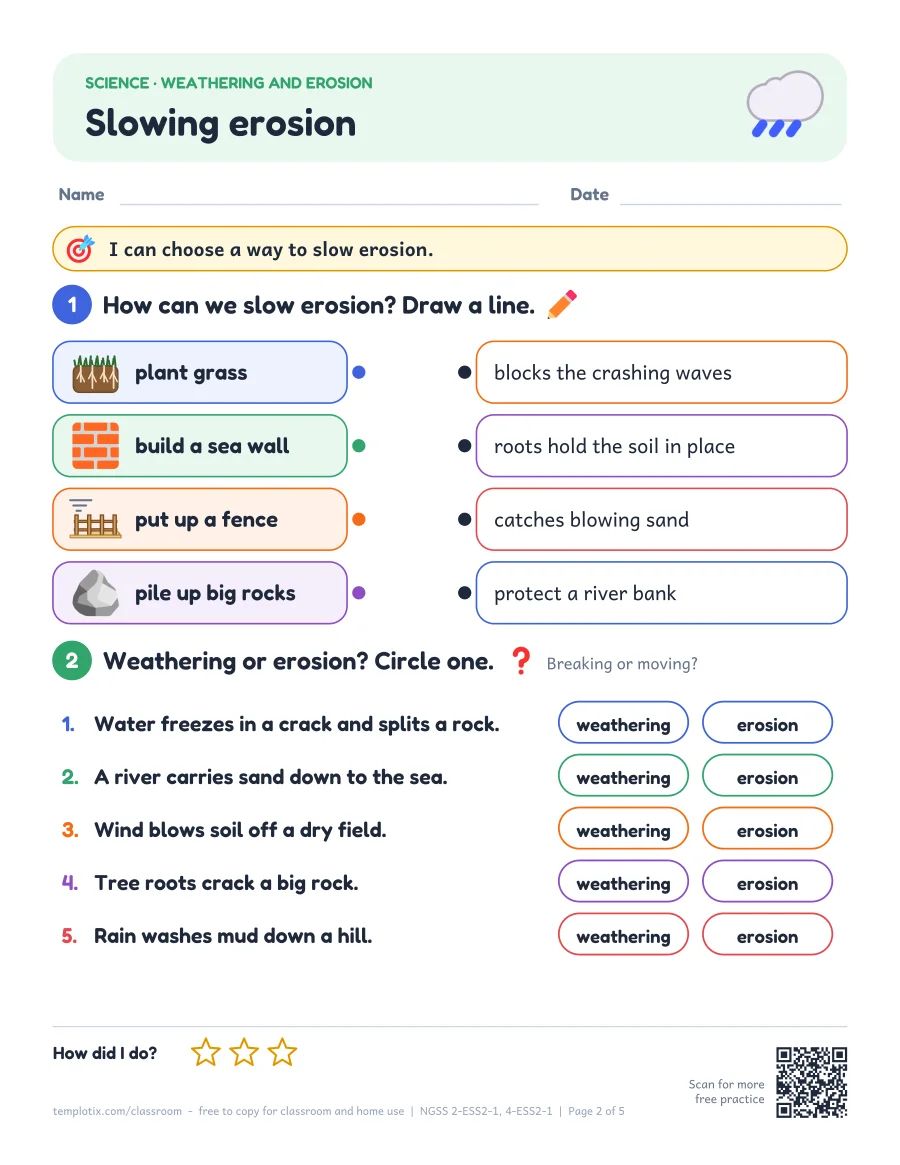
Weathering breaks rock into smaller pieces where it is. Erosion moves those pieces to a new place. Ice cracking a rock is weathering; a river carrying the sand away is erosion.
How can people slow erosion?
Plant grass, trees and bushes, whose roots hold soil in place. Build walls, fences and terraces, and cover bare soil with mulch so rain and wind cannot carry it away.
What grade learns weathering and erosion?
Usually 2nd to 4th grade. In the Next Generation Science Standards (NGSS) it supports 2-ESS2-1 and 4-ESS2-1.
Is there a hands-on experiment?
Yes. Page 4 is a Try it! experiment, the rain hill test, with a materials list, a prediction and an observation chart. Safety: a grown-up pokes the holes in the cup. Work outside or on a tray, and wash hands after.
Is there an answer key?
Yes. Page 5 has every answer from the pack, what to expect from the experiment and a short teaching tip.