Shop
 Grade workbooks


Classroom · Science · Human body · 3rd and 4th grade
Bones and muscles worksheets
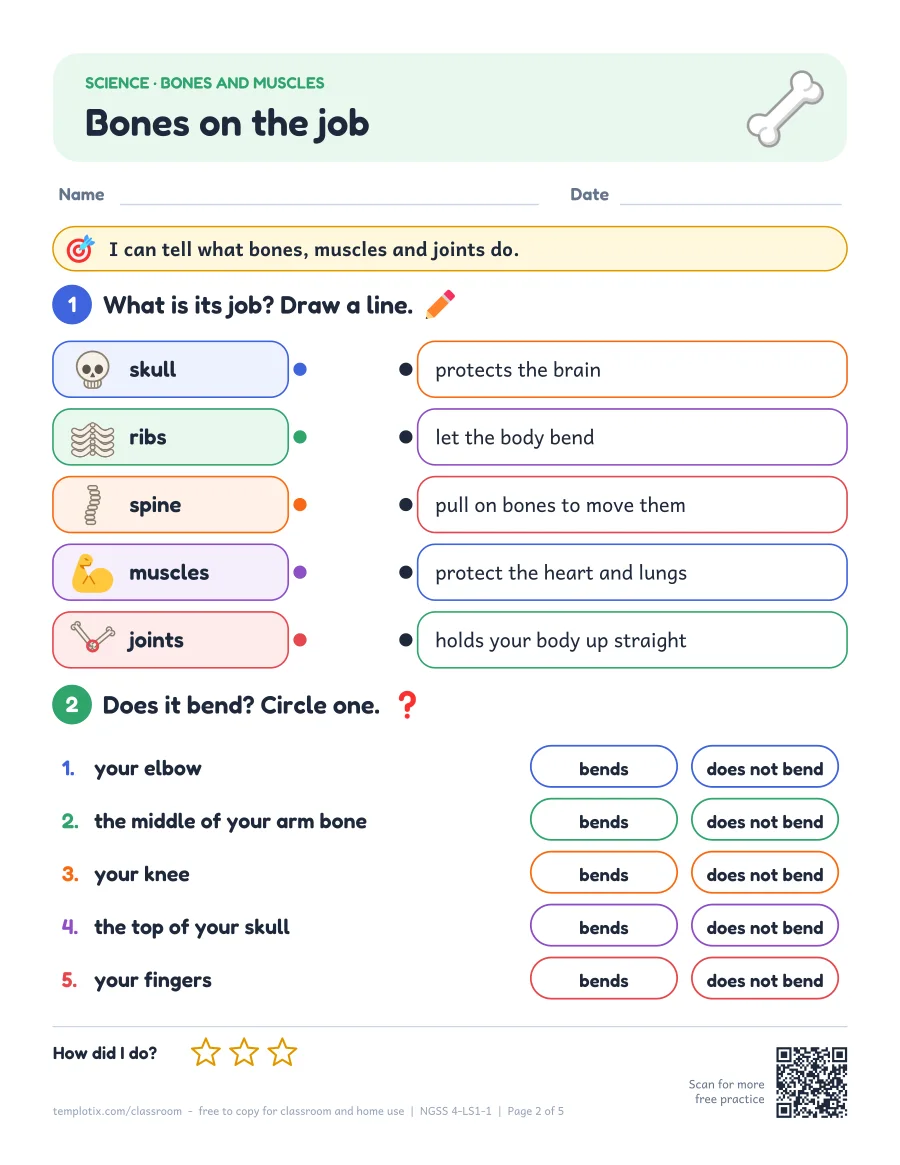
A free five-page science pack for 3rd and 4th grade: learn to explain how bones and muscles help the body move, with a labeled picture, practice pages, a hands-on experiment and an answer key.
The big idea
 The big idea
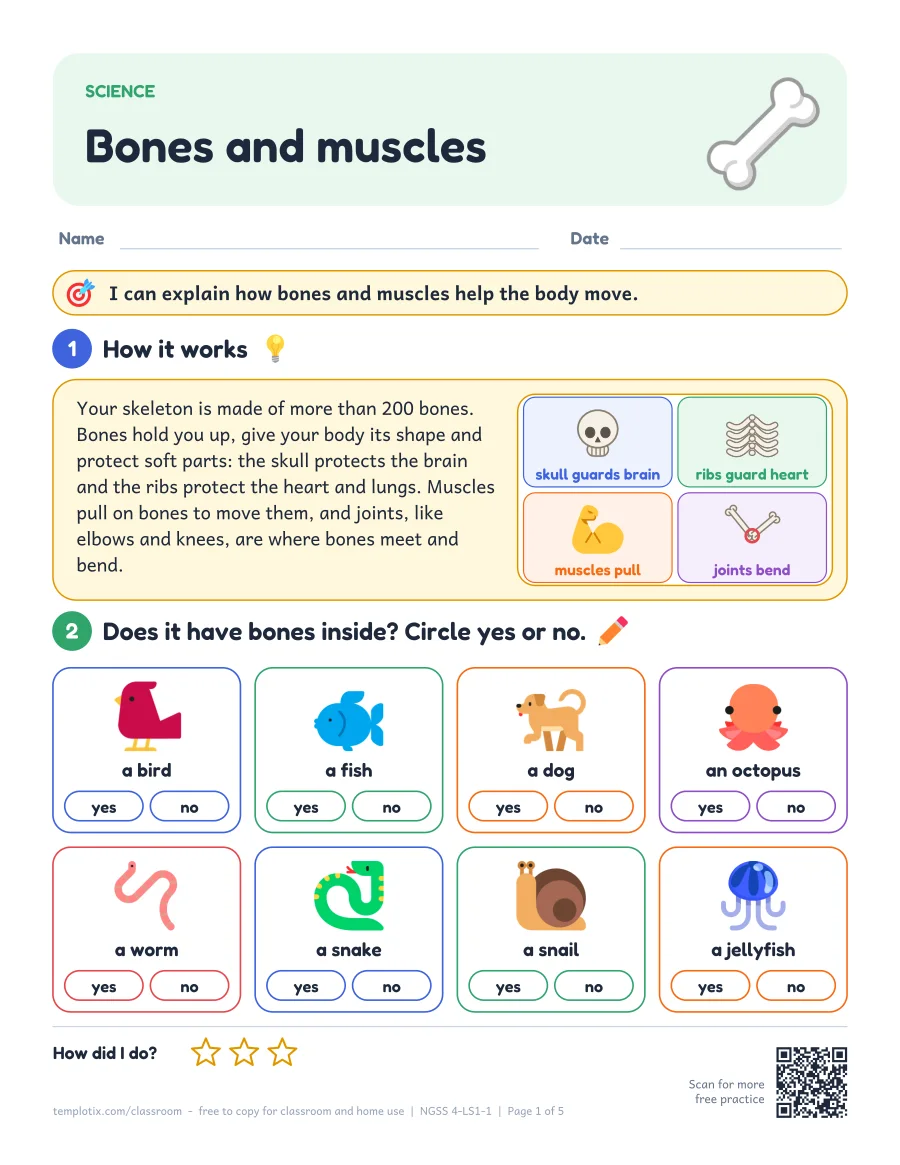
Your skeleton is made of more than 200 bones. Bones hold you up, give your body its shape and protect soft parts: the skull protects the brain and the ribs protect the heart and lungs. Muscles pull on bones to move them, and joints, like elbows and knees, are where bones meet and bend.
Teaching tip
 Teaching tip
Have children hold their upper arm while they bend and straighten the elbow. They can feel the muscle get short and hard as it pulls.
Try it: the thumb test
 Try it: the thumb test
I can test how a joint helps me move.
You need
- Soft tape
- A pencil
- A book
- A timer
- A partner
What to do
- 1Time how long it takes to pick up a pencil, turn a page and write your name.
- 2Gently tape your thumb to the side of your hand.
- 3Time the same 3 jobs again.
- 4Take the tape off. Compare your times.
Predict first: Will the jobs be easier or harder with your thumb taped?What happens?
Every job is harder and slower with the thumb taped. The thumb has joints that let it bend and reach across to the fingers, so we can grip and pinch. Joints are where bones meet, and they let our bodies move in many ways.
Safety: tape gently on the outside of the hand only, and take it off right after.
Quick check
What does the skeleton do?Tap to checkIt holds us up, gives us shape and protects soft parts
What protects the brain?Tap to checkThe skull
What protects the heart and lungs?Tap to checkThe ribs
How do muscles move bones?Tap to checkThey pull on them
What is a joint?Tap to checkA place where bones meet and bend
Name a joint.Tap to checkElbow, knee, wrist, shoulder or knuckle
What the worksheets look like
Five senses poster
 Five senses poster
One colorful page with the five senses (sight, hearing, smell, taste and touch), the body part for each and how the brain puts the messages together. Made for a science wall.
Common questions
How many bones are in the human body?
An adult has 206 bones. A baby is born with about 270, and some of them grow together as the child gets older.
How do muscles move bones?
Muscles can only pull, not push, so they work in pairs. To bend your arm, the biceps on the front pulls. To straighten it, the triceps on the back pulls.
What grade learns bones and muscles?
Usually 3rd and 4th grade. In the Next Generation Science Standards (NGSS) it supports 4-LS1-1.
Is there a hands-on experiment?
Yes. Page 4 is a Try it! experiment, the thumb test, with a materials list, a prediction and an observation chart. Safety: tape gently on the outside of the hand only, and take it off right after.
Is there an answer key?
Yes. Page 5 has every answer from the pack, what to expect from the experiment and a short teaching tip.