Shop
 Grade workbooks


Classroom · Science · NGSS 4-PS3, 4-PS4, 4-ESS3
worksheets for 3rd to 5th grade
Where does energy come from, and where does it go? These free energy worksheets cover light, heat, sound and motion, how electricity flows around a circuit, what happens to energy in a collision, sound waves, and renewable and nonrenewable energy. Each pack has a clear picture, practice pages, a Think like a scientist page and a hands-on experiment, then ends with an answer key.
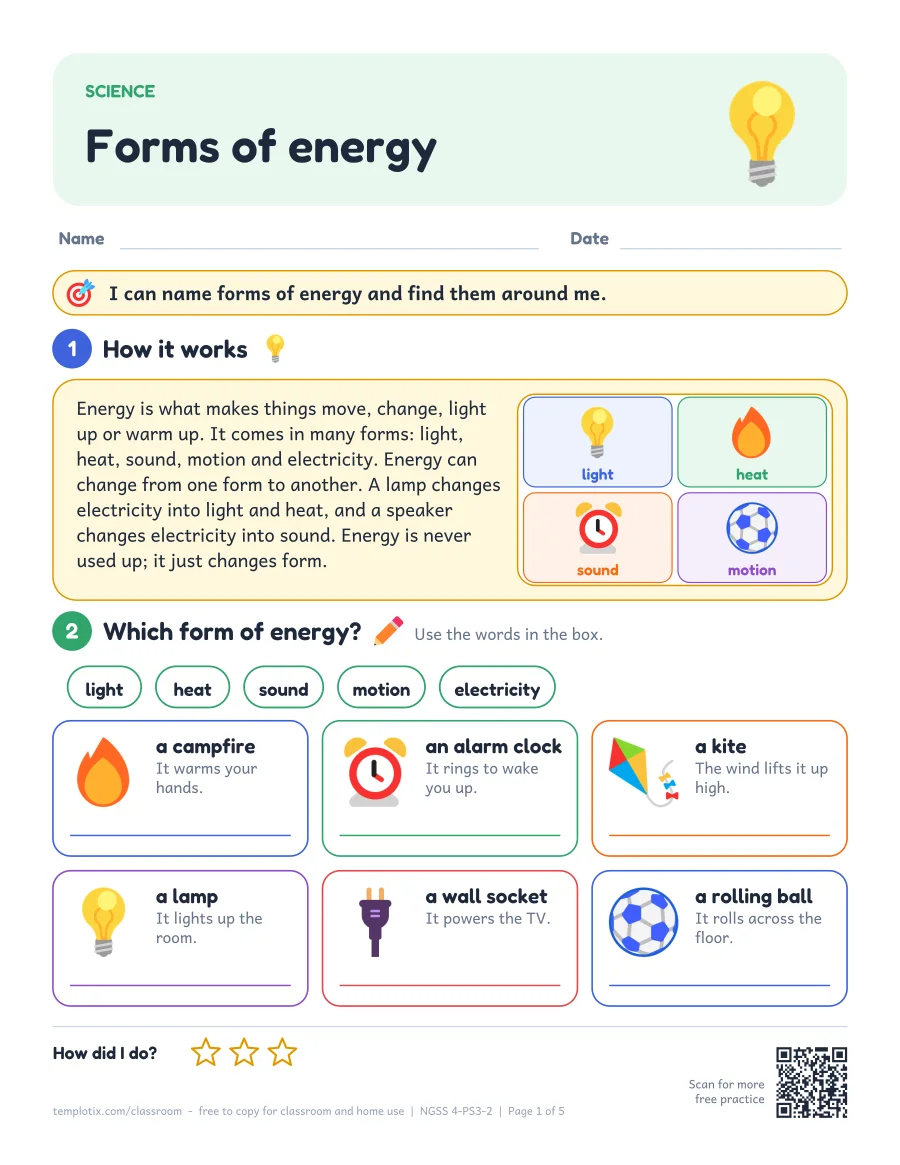
- Forms of energy3rd and 4th grade · NGSS 4-PS3-2
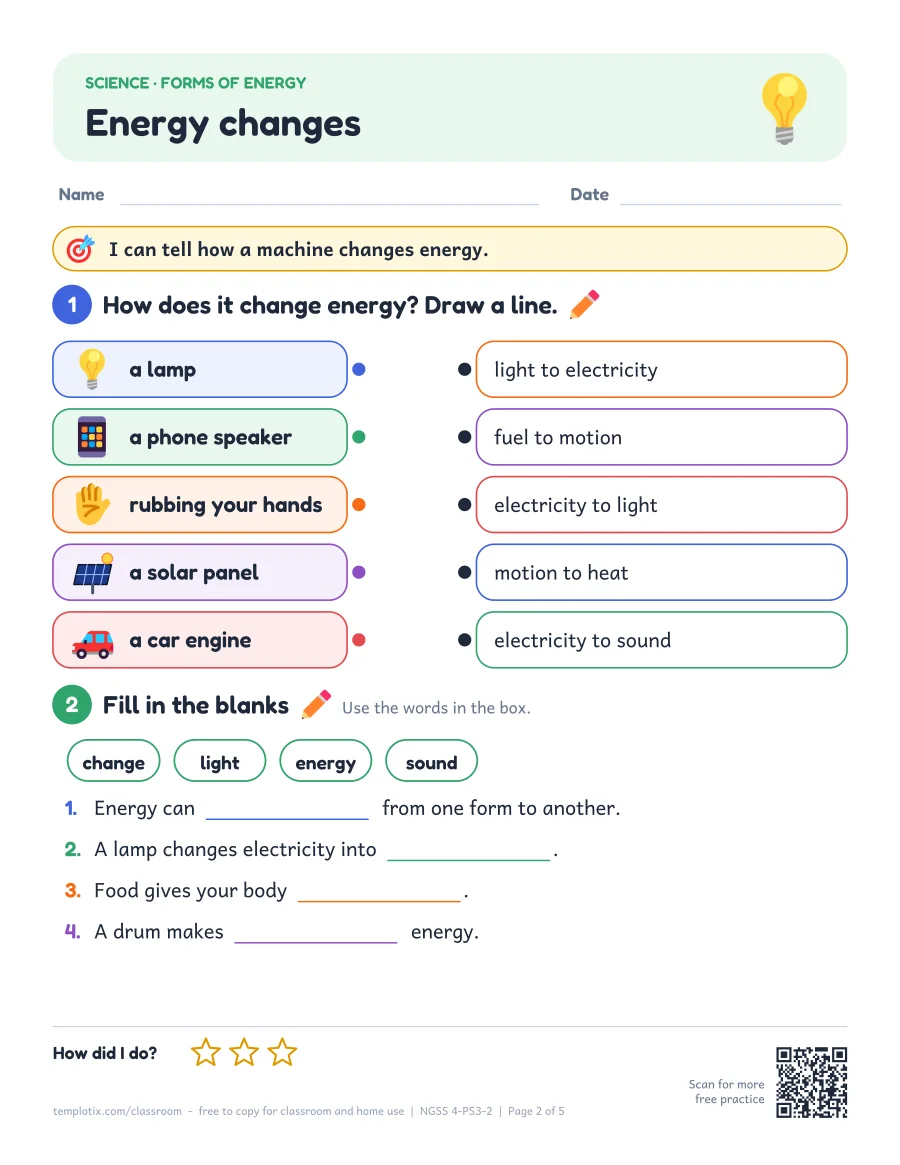
Energy is what makes things move, change, light up or warm up. It comes in many forms: light, heat, sound, motion and electricity. Energy can change from one form to another. A lamp changes electricity into light and heat, and a speaker changes electricity into sound. Energy is never used up; it just changes form.
- Heat energy3rd and 4th grade · NGSS 4-PS3-2
Heat always moves from something warmer to something cooler. Your hand warms an ice cube, and a hot drink warms the mug. Some materials, called conductors, let heat move through them quickly; most metals are good conductors. Others, called insulators, slow heat down, like wool, wood, plastic and air trapped in a coat.
- Electricity and circuits4th grade · NGSS 4-PS3-2, 4-PS3-4
Electricity is energy that flows along a path called a circuit. A simple circuit has a battery, wires and something to power, like a bulb. The path must be closed, with no gaps, for the electricity to flow. A switch opens or closes the gap. Metals are conductors that let electricity flow; plastic, rubber and wood are insulators that stop it.
- Energy and collisions4th grade · NGSS 4-PS3-1, 4-PS3-3
Everything that moves has energy, and the faster it moves, the more energy it has. When two objects collide, energy moves from one to the other: a rolling ball hits a pin and the pin moves. Some of the energy also changes into sound and heat, which is why a crash makes a noise and brakes get warm.
- Renewable and nonrenewable energy4th and 5th grade · NGSS 4-ESS3-1, 5-ESS3-1
We use energy sources to make electricity and to run cars and homes. Renewable sources, like sunlight, wind and moving water, will not run out. Nonrenewable sources, like coal, oil and natural gas, took millions of years to form underground, so once we use them up they are gone. Burning them can also pollute the air, so saving energy helps the planet.
- Sound and waves4th grade · NGSS 4-PS4-1
Sound is made when something vibrates, or moves back and forth very fast. The vibrations travel as waves through air, water and solids to your ears. Taller waves carry more energy and sound louder. Waves that are closer together sound higher; waves that are farther apart sound lower. Sound cannot travel through empty space.






Energy all around poster
 Energy all around poster
One colorful page with light, heat, sound, motion, electricity and renewable energy, each with a picture and a one-line meaning. Made for a science wall.
What is in each pack
- 1. Learn itA short explanation with a clear, labeled picture, then a first activity.
- 2. PracticeSorting, matching, comparing and fill in the blanks.
- 3. Think like a scientistWhy questions, true or false and a drawing that explains an idea.
- 4. Try it!A hands-on activity with a materials list, a prediction and an observation chart.
- 5. Answer keyEvery answer, what to expect from the activity, a teaching tip and a safety note.


How to teach energy
- Start with "in and out". For any machine, ask what energy goes in and what comes out. A lamp: electricity in, light and heat out.
- Feel it. Rub hands together for heat, hum with a hand on the throat for sound, and roll a ball for motion.
- Test, don't tell. Let children predict, then build the circuit or race the spoons before you explain why.
- Talk about safety. Batteries are for experiments; wall sockets and anything hot are for adults.
- Go hunting. A ten-minute energy hunt or audit around the room makes every form of energy easy to spot.
More science
Common questions
Are these energy worksheets free?
Yes. Every energy pack and the poster are free to download, print and copy for your class or home, in color or in a black-and-white ink saver.
What grade are these energy worksheets for?
3rd to 5th grade, with most topics written for 4th grade, where energy is taught in the NGSS. Forms of energy and heat suit 3rd grade too, and renewable energy reaches into 5th grade.
Are the electricity experiments safe?
Yes. The circuit activity uses one small 1.5-volt battery, a bulb and two wires. The safety note on every answer key reminds children never to use a wall socket or take a battery apart.
Do the worksheets follow the NGSS?
Yes. Each pack names the NGSS performance expectation it supports, for example 4-PS3-4 for circuits, 4-PS3-3 for collisions and 4-PS4-1 for sound waves.