Shop
 Grade workbooks


Classroom · Science · Animals · 1st and 2nd grade
Animal body parts worksheets
A free five-page science pack for 1st and 2nd grade: learn to tell how an animal's body parts help it live, with a labeled picture, practice pages, a hands-on experiment and an answer key.
The big idea
 The big idea
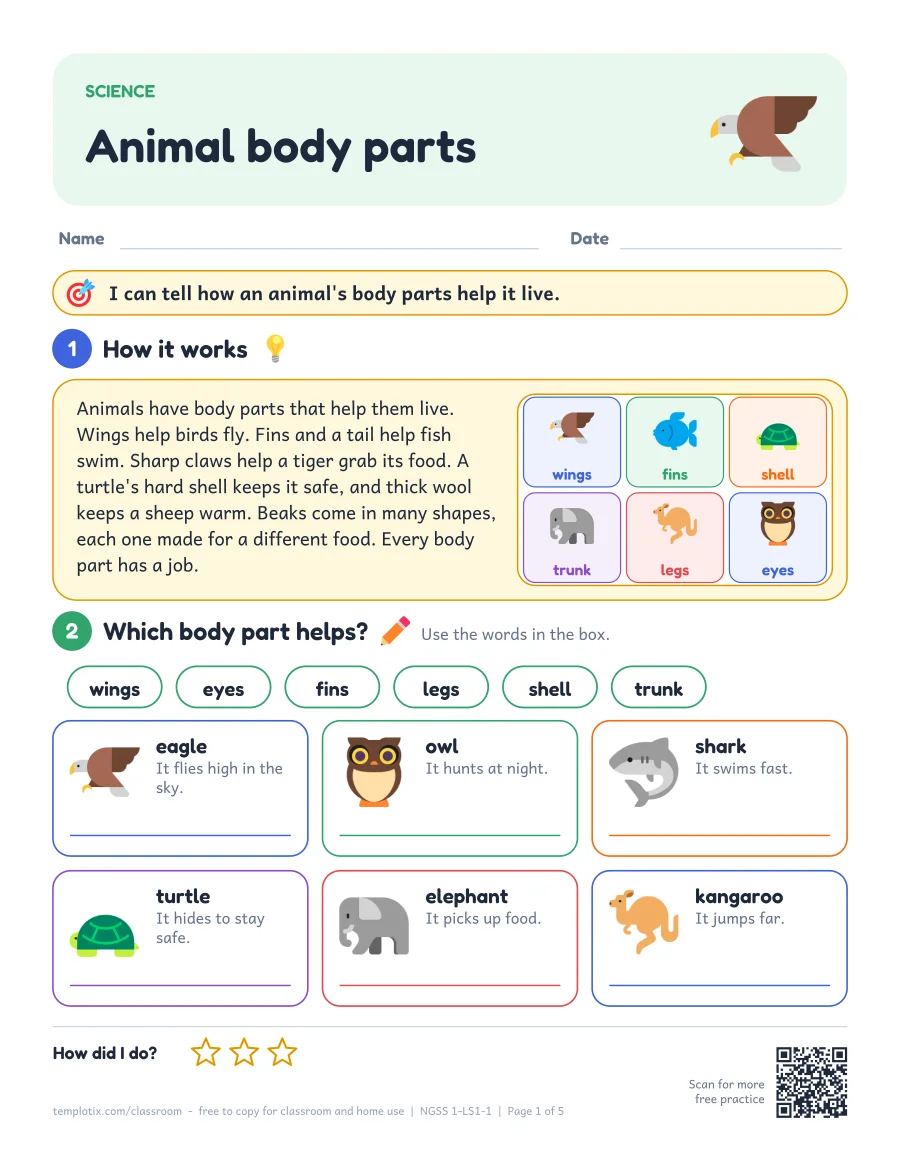
Animals have body parts that help them live. Wings help birds fly. Fins and a tail help fish swim. Sharp claws help a tiger grab its food. A turtle's hard shell keeps it safe, and thick wool keeps a sheep warm. Beaks come in many shapes, each one made for a different food. Every body part has a job.
Teaching tip
 Teaching tip
After the beak challenge, show photos of real birds (a hummingbird, a duck, an eagle and a parrot) and ask children which tool matched each beak. Then ask them which of their own body parts work like tools.
Try it: the bird beak challenge
 Try it: the bird beak challenge
I can test which beak works best for each food.
You need
- Tweezers
- A clothespin
- A spoon
- A straw
- Rice, cereal and water
What to do
- 1Put a pile of rice, a pile of cereal and a cup of water on the table.
- 2Each tool is a beak. Try each beak on each food for 30 seconds.
- 3Count how many pieces each beak picks up. Try to sip the water with each one too.
- 4Compare: which beak works best for which food?
Predict first: Which beak will pick up the most rice?What happens?
The tweezers pick up small rice grains best, like a thin, pointed beak picking up seeds or bugs. The spoon scoops lots of cereal at once, like a duck's wide bill. Only the straw can sip the water, like a hummingbird drinking nectar. Different beaks are made for different foods.
Safety: do not eat the food after the test. Be careful with the pointed tweezers.
Quick check
What do wings help a bird do?Tap to checkFly
What do fins help a fish do?Tap to checkSwim
How does a shell help a turtle?Tap to checkIt keeps the turtle safe
What does an elephant use its trunk for?Tap to checkTo pick up food and drink water
Why do owls have big eyes?Tap to checkTo see at night
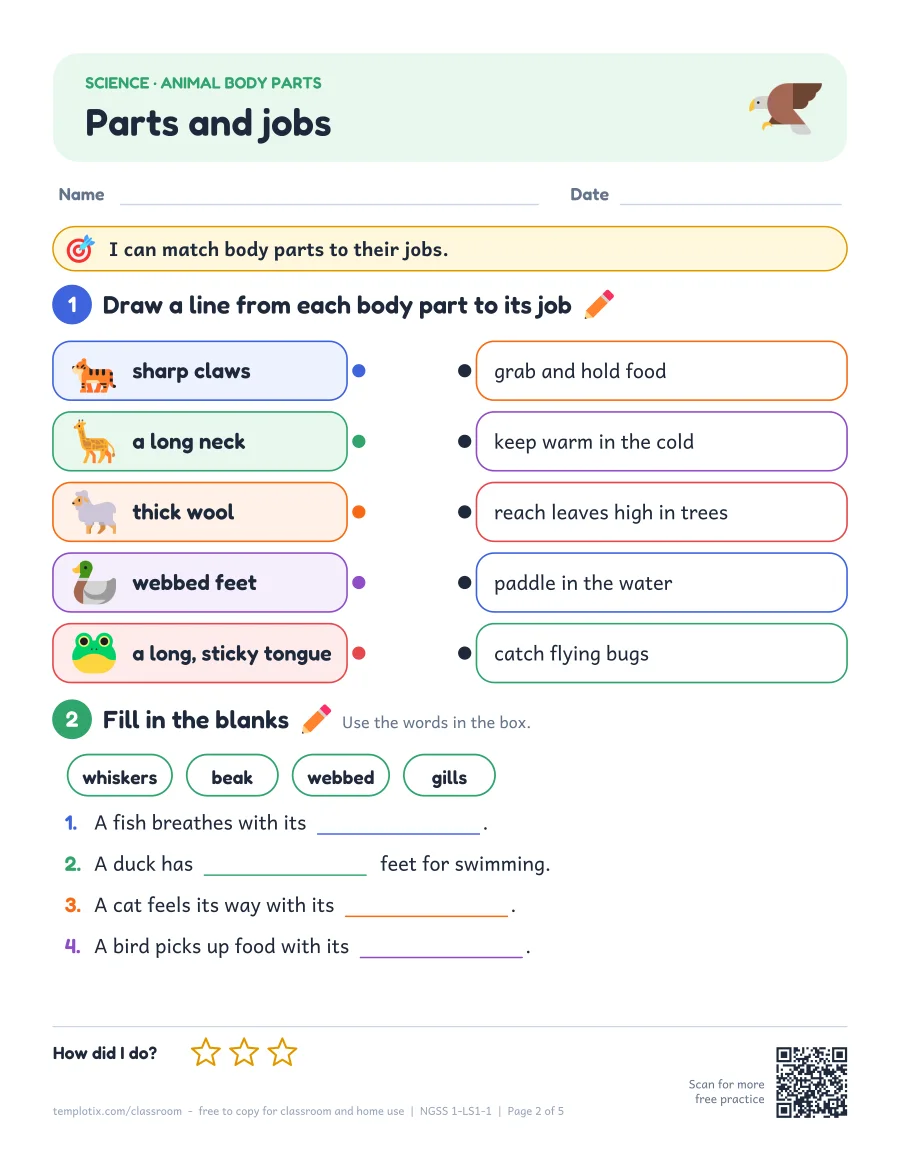
What does a duck use its webbed feet for?Tap to checkTo paddle in the water
What the worksheets look like
Animal habitats poster
 Animal habitats poster
One colorful page with six habitats (ocean, desert, polar lands, rainforest, pond and forest) and three animals that live in each. Made for a science wall.
Common questions
How do body parts help animals survive?
Each part does a job in the animal's home. A duck's webbed feet paddle through water, an eagle's sharp eyes spot food from high up, and a porcupine's quills keep hungry animals away.
How can kids compare animal body parts?
Pick one job, like moving or eating, and compare animals that do it in different ways: a bird uses wings, a fish uses fins and a snake uses its whole body. Then ask which body part fits which home.
What grade learns animal body parts?
Usually 1st and 2nd grade. In the Next Generation Science Standards (NGSS) it supports 1-LS1-1.
Is there a hands-on experiment?
Yes. Page 4 is a Try it! experiment, the bird beak challenge, with a materials list, a prediction and an observation chart. Safety: do not eat the food after the test. Be careful with the pointed tweezers.
Is there an answer key?
Yes. Page 5 has every answer from the pack, what to expect from the experiment and a short teaching tip.