Shop
 Grade workbooks


Classroom · Science · Weather · 2nd and 3rd grade

Types of clouds worksheets
A free five-page science pack for 2nd and 3rd grade: learn to name four kinds of clouds and the weather they bring, with a labeled picture, practice pages, a hands-on experiment and an answer key.
The big idea
 The big idea
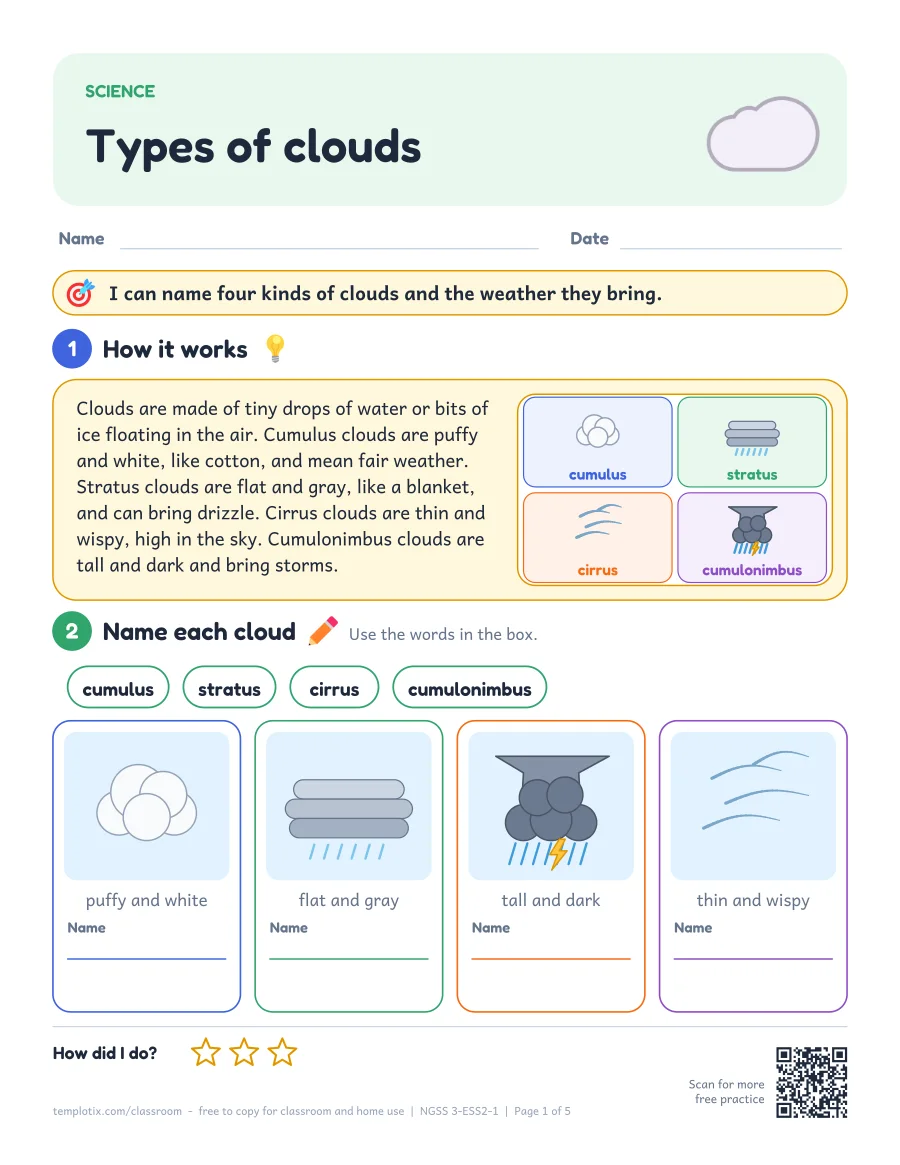
Clouds are made of tiny drops of water or bits of ice floating in the air. Cumulus clouds are puffy and white, like cotton, and mean fair weather. Stratus clouds are flat and gray, like a blanket, and can bring drizzle. Cirrus clouds are thin and wispy, high in the sky. Cumulonimbus clouds are tall and dark and bring storms.
Teaching tip
 Teaching tip
Give each child a cotton ball, a strip of gray paper and a white chalk line on blue paper to model cumulus, stratus and cirrus clouds. Comparing real clouds to the models makes the names stick.
Try it: cloud watch
 Try it: cloud watch
I can observe clouds and use them to predict the weather.
You need
- A notebook
- A pencil
- Crayons
- A window or a yard
- This cloud guide
What to do
- 1Look at the sky at the same time each day for 3 days. Never look at the sun.
- 2Draw the clouds you see. Are they puffy, flat, wispy or tall?
- 3Name the clouds with the guide on page 1.
- 4Later that day, write what the weather did.
Predict first: Can clouds help you guess the weather?What happens?
Answers will vary. Puffy cumulus clouds usually come with fair weather. A flat gray stratus layer often brings a gray day or drizzle. Tall, dark cumulonimbus clouds often come before a storm, and high cirrus clouds can mean the weather will change in a day or so.
Safety: never look straight at the sun, even through clouds. Go inside if you hear thunder.
Quick check
What are clouds made of?Tap to checkTiny drops of water or bits of ice
What do cumulus clouds look like?Tap to checkPuffy and white, like cotton
What do stratus clouds look like?Tap to checkFlat and gray, like a blanket
What do cirrus clouds look like?Tap to checkThin and wispy, high in the sky
Which clouds bring storms?Tap to checkCumulonimbus clouds
What is fog?Tap to checkA cloud near the ground
What the worksheets look like
Water cycle poster
 Water cycle poster
One colorful page with a labeled water cycle picture and the four steps: evaporation, condensation, precipitation and collection. Made for a science wall.
Common questions
What are the main types of clouds?
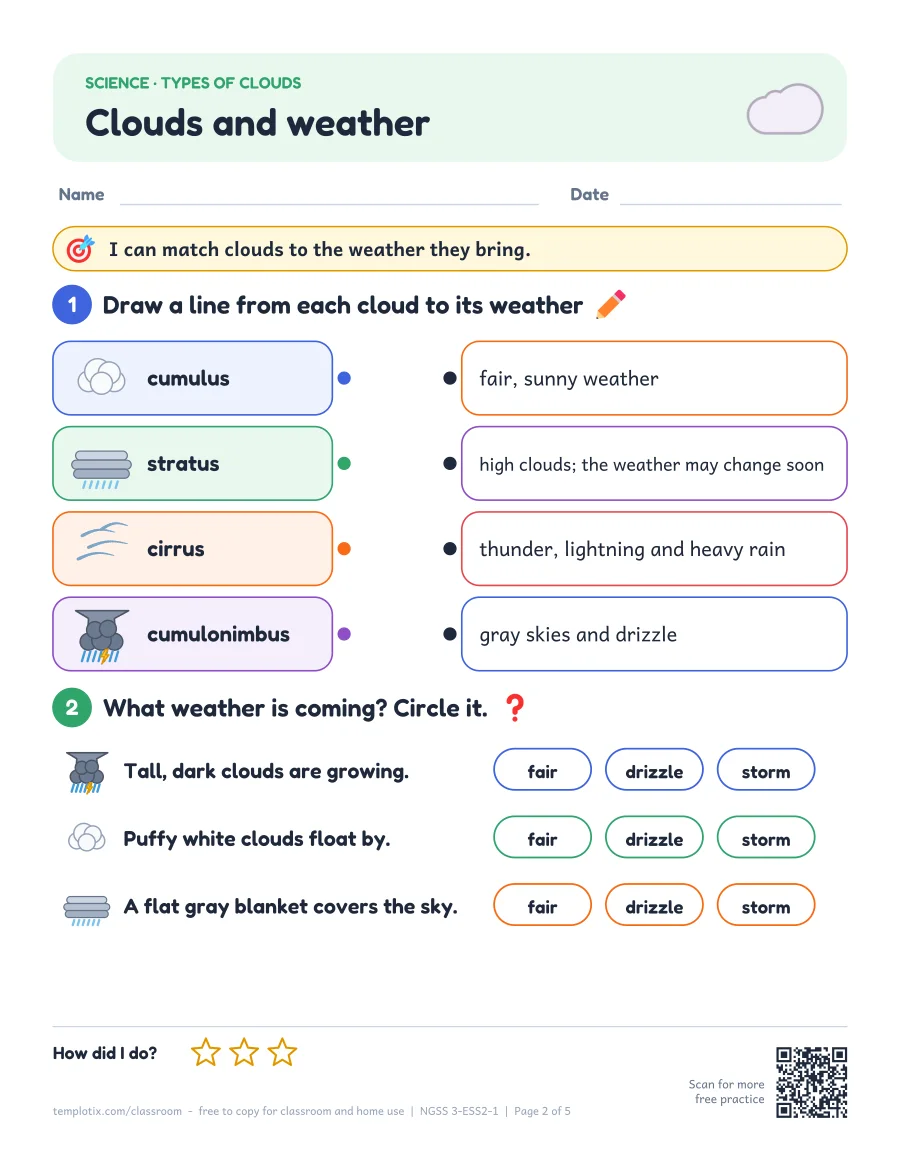
Cumulus clouds are puffy and white, stratus clouds are flat gray layers, cirrus clouds are thin and wispy high in the sky, and cumulonimbus clouds are tall storm clouds. With these four names, children can name most clouds they see.
Can clouds help predict the weather?
Yes. Cumulonimbus clouds mean a thunderstorm may come soon. Low stratus clouds often bring drizzle. Cirrus clouds can mean the weather will change in a day or so.
What grade learns types of clouds?
Usually 2nd and 3rd grade. In the Next Generation Science Standards (NGSS) it supports 3-ESS2-1.
Is there a hands-on experiment?
Yes. Page 4 is a Try it! experiment, cloud watch, with a materials list, a prediction and an observation chart. Safety: never look straight at the sun, even through clouds. Go inside if you hear thunder.
Is there an answer key?
Yes. Page 5 has every answer from the pack, what to expect from the experiment and a short teaching tip.