Shop
 Grade workbooks


Classroom · Science · NGSS 3-LS2, 3-LS4, 5-LS1, 5-LS2, 5-ESS3
worksheets for 3rd to 5th grade
Who eats what, and where does the energy come from? These free ecosystem worksheets follow energy from the sun to plants, animals and decomposers, through food chains and food webs, predators and prey, and the changes that shape every habitat. Each pack has a clear picture, practice pages, a Think like a scientist page and a hands-on experiment, then ends with an answer key.
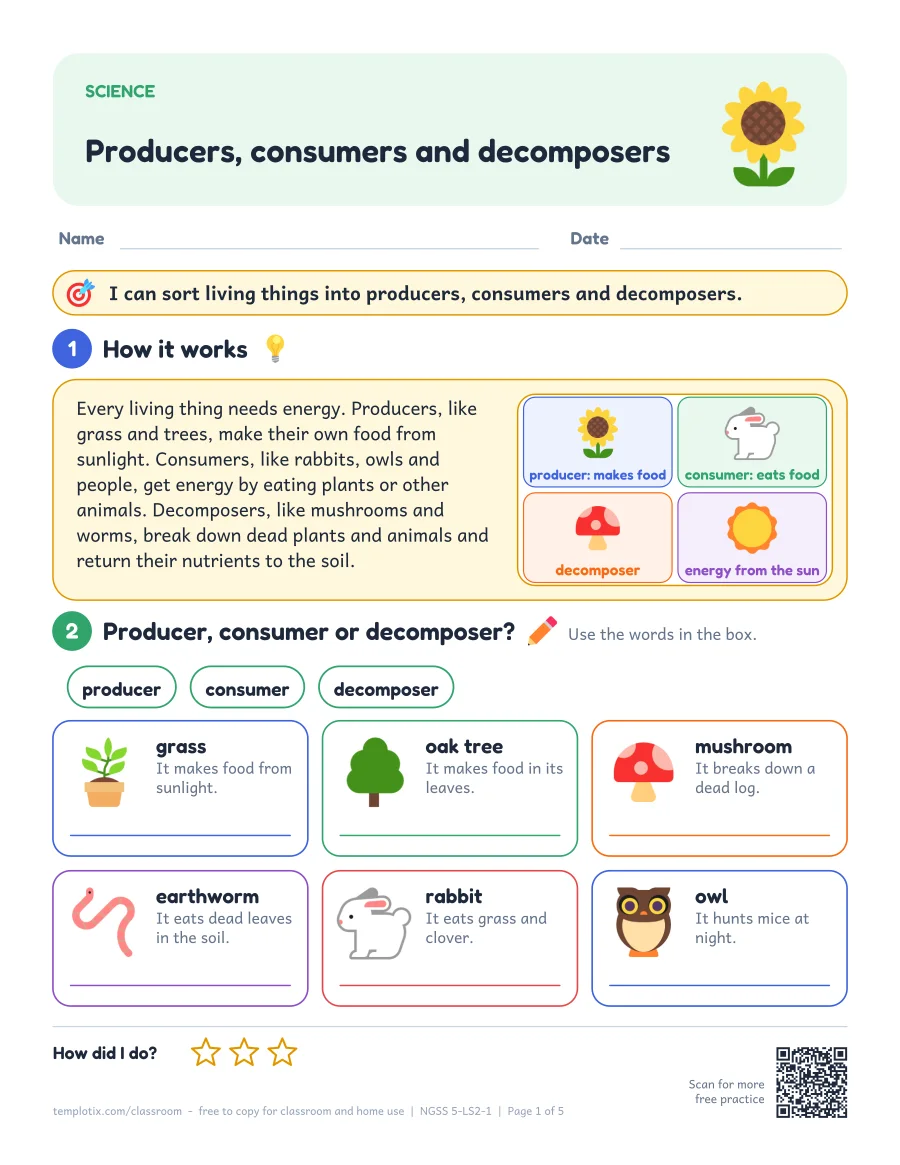
- Producers, consumers and decomposers3rd to 5th grade · NGSS 5-LS2-1
Every living thing needs energy. Producers, like grass and trees, make their own food from sunlight. Consumers, like rabbits, owls and people, get energy by eating plants or other animals. Decomposers, like mushrooms and worms, break down dead plants and animals and return their nutrients to the soil.
- Food chains3rd to 5th grade · NGSS 5-LS2-1, 5-PS3-1
A food chain shows how energy moves from one living thing to the next. It starts with the sun and a producer, like grass. The arrows point from the food to the eater: grass, then rabbit, then fox means the rabbit eats the grass and the fox eats the rabbit. Each arrow means "gives energy to".
- Food webs4th and 5th grade · NGSS 5-LS2-1
Most animals eat more than one kind of food, and most are eaten by more than one animal. A food web joins many food chains together to show all of these links. Because everything is connected, a change to one living thing, like fewer mice, changes the lives of others, like the owls and snakes that eat them.
- Predators and prey3rd and 4th grade · NGSS 3-LS2-1, 4-LS1-1
A predator is an animal that hunts other animals for food, like an owl or a shark. Prey is the animal that gets hunted, like a mouse or a fish. Both have body parts that help them: predators have sharp claws and teeth and eyes that face forward, while prey animals have eyes on the sides, fast legs and colors that help them hide.
- How plants make food4th and 5th grade · NGSS 5-LS1-1, 5-PS3-1
Plants make their own food. In their leaves, they use the energy of sunlight to turn water and carbon dioxide, a gas from the air, into sugar. This is called photosynthesis. The plant uses the sugar to live and grow, and it gives off oxygen, the gas that people and animals breathe.
- Changes in ecosystems3rd to 5th grade · NGSS 3-LS4-4, 5-ESS3-1
An ecosystem is all the living and nonliving things in one place, working together. Ecosystems change: a storm knocks down trees, a dry summer shrinks a pond, or people build a road. When a place changes, some living things adapt, some move away and some cannot survive. People can harm ecosystems with litter and pollution, and help them by planting trees and protecting habitats.






Who eats what? poster
 Who eats what? poster
One colorful page with a food chain, producers, consumers, decomposers, predators, prey and food webs, each with a picture and a one-line meaning. Made for a science wall.
What is in each pack
- 1. Learn itA short explanation with a clear, labeled picture, then a first activity.
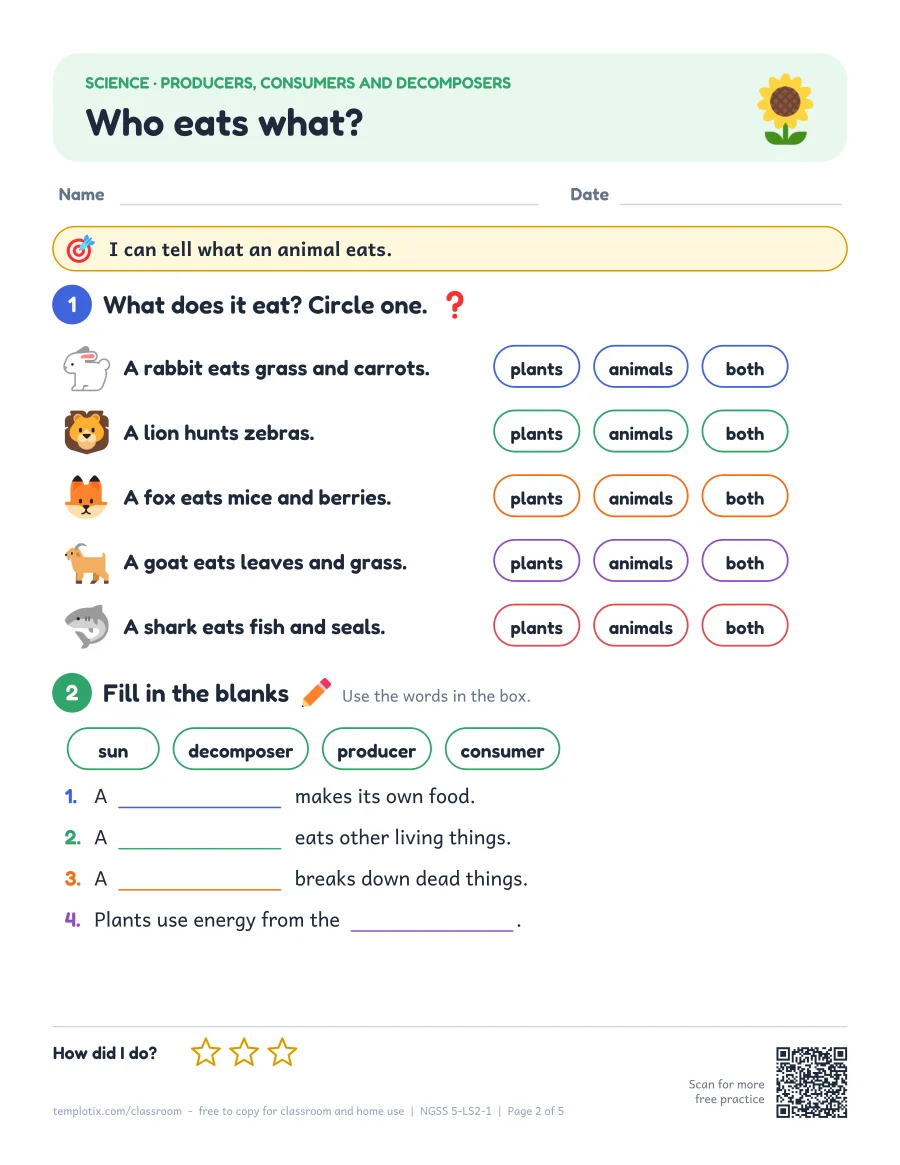
- 2. PracticeSorting, ordering, matching and fill in the blanks.
- 3. Think like a scientistWhy questions, true or false and a drawing that explains an idea.
- 4. Try it!A hands-on activity with a materials list, a prediction and an observation chart.
- 5. Answer keyEvery answer, what to expect from the activity, a teaching tip and a safety note.


How to teach ecosystems and food chains
- Start with lunch. Trace each food back to a plant: cheese comes from a cow, and the cow ate grass.
- Say "is eaten by". It keeps food chain arrows pointing the right way, from the food to the eater.
- Go outside. A ten-minute schoolyard survey turns producers, consumers and decomposers into things children can count.
- Play the web. A yarn food web shows in seconds how one change tugs on everything else.
- Ask "what if?" What if the rain stopped, or the owls left? Predicting changes is the heart of ecosystem science.
More science
Common questions
Are these ecosystem and food chain worksheets free?
Yes. Every ecosystem pack and the poster are free to download, print and copy for your class or home, in color or in a black-and-white ink saver.
What grade are these food chain worksheets for?
3rd to 5th grade. Predators and prey and producers and consumers suit 3rd grade, food chains fit 3rd to 5th grade, and food webs and how plants make food are 4th and 5th grade topics.
Do I need special supplies for the experiments?
No. The Try it! pages use everyday things, such as a hoop or a loop of string, paper strips, a ball of yarn, cups of water, a few leaves and gloves for a litter walk.
Do the worksheets follow the NGSS?
Yes. Each pack names the NGSS performance expectation it supports, for example 5-LS2-1 for food chains and food webs and 5-LS1-1 for how plants make food.