Shop
 Grade workbooks


Classroom · Math · CCSS 2.OA.C.4, 3.OA.A.1, 3.OA.A.3, 3.OA.B.5
worksheets for 2nd and 3rd grade
Understand what multiplication means before memorizing facts: equal groups, repeated addition, arrays, jumps on a number line, turn-around facts and breaking a fact apart. Every page uses pictures and dot arrays so children can see the answer, not just recall it.
- Equal groups2nd and 3rd grade
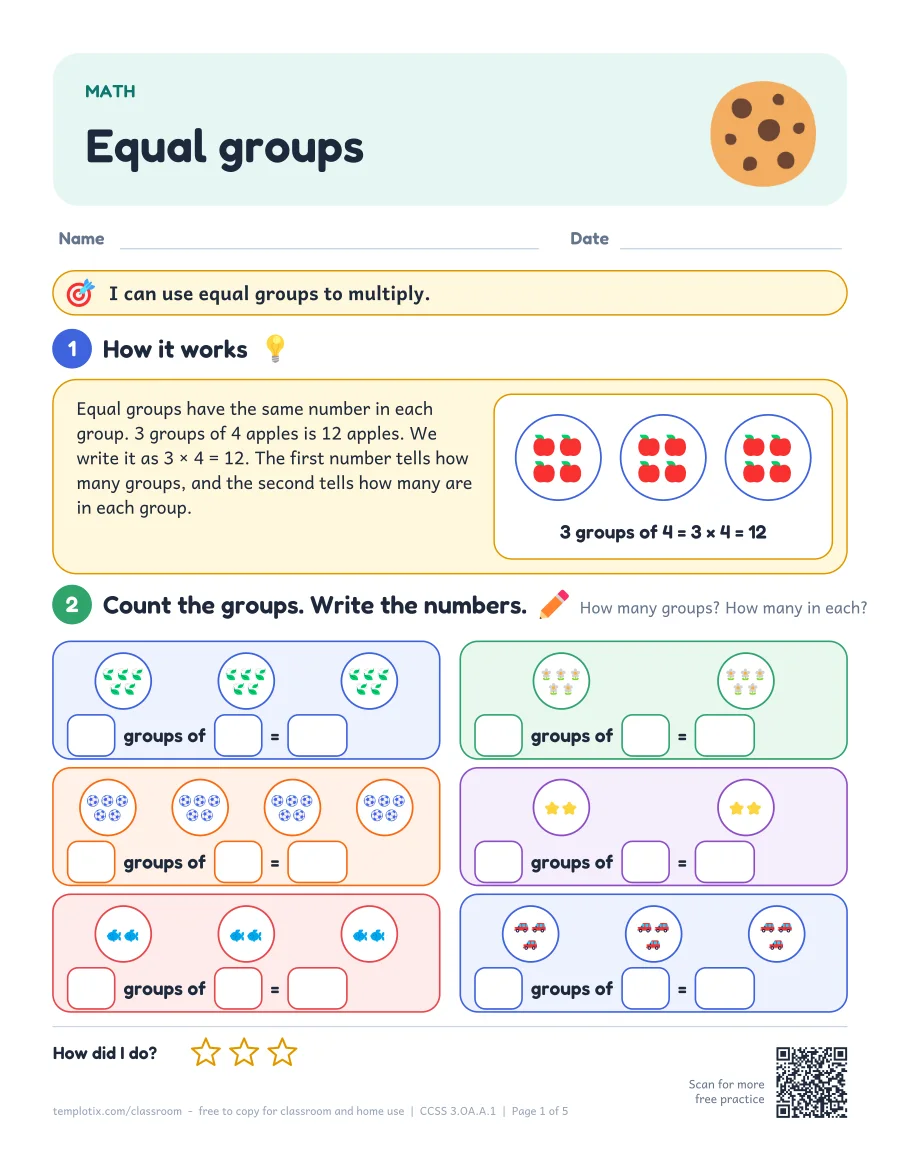
Equal groups have the same number in each group. 3 groups of 4 apples is 12 apples. We write it as 3 × 4 = 12. The first number tells how many groups, and the second tells how many are in each group.
- Repeated addition2nd grade
When you add the same number again and again, you can multiply instead. 4 + 4 + 4 adds three 4s, so it is 3 × 4 = 12. Count how many times the number is added: that is the first factor.
- Arrays2nd and 3rd grade
An array has equal rows. 3 rows of 5 dots is 3 × 5 = 15. Count the rows first, then how many are in each row. An array is easy to count because every row is the same.
- Multiplication on a number line3rd grade
Start at 0 and make equal jumps. 3 jumps of 5 land on 15, so 3 × 5 = 15. The number of jumps is the first factor, the size of each jump is the second, and where you land is the product.
- Commutative property of multiplication3rd grade
You can multiply numbers in any order and get the same answer. 2 × 4 = 8 and 4 × 2 = 8. Turn an array on its side and the total stays the same. If you know one fact, you know its turn-around fact too.
- Distributive property of multiplication3rd grade
A hard fact can be split into easier ones. To find 4 × 7, split 7 into 5 and 2: 4 × 5 = 20 and 4 × 2 = 8, so 4 × 7 = 20 + 8 = 28. Draw a line through the array to see the two parts.






Six ways to multiply poster
 Six ways to multiply poster
4 × 3 shown as groups, addition, an array, jumps, a turn-around and a split.
Whole unit in one PDF Plus
 Whole unit in one PDF
All multiplication strategies packs, the unit chart and a contents page: 32 pages, ready to print. For Templotix Plus members.
What is in each pack
- 1. Learn itThe strategy with a picture, then first practice.
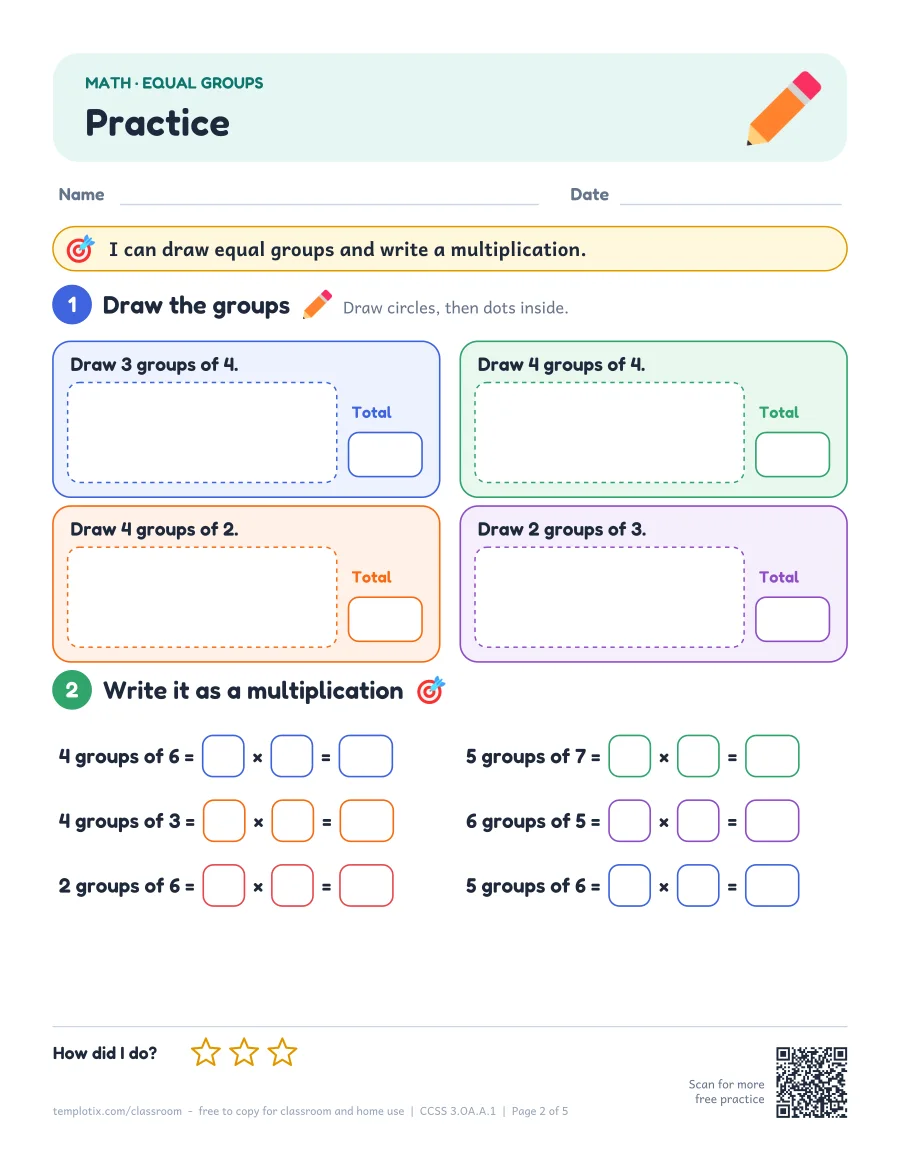
- 2. PracticeDraw groups, arrays and jumps, then write the facts.
- 3. Think deeperEqual or not, true or false, hidden arrays and two ways.
- 4. Word problemsFour real-life stories to draw and solve.
- 5. Answer key and tipEvery answer on one page, plus a teaching tip for grown-ups.


How to teach multiplication strategies
- Use real things. Make equal groups with counters, cereal or blocks before the worksheet.
- Say it in words. "4 groups of 3" and "4 rows of 3" help children see what the × sign means.
- Connect the strategies. Show the same fact as groups, an array and jumps so children see they all give the same answer.
- Then learn the facts. Once the meaning is clear, move on to the times tables for fluency.
More math
- Telling time
- Money
- Fractions
- Division
- Multi-digit multiplication
- Decimals
- Greater than and less than
- Skip counting
- Shapes
- Number bonds
- Graphs and data
- Measurement
- Area and Perimeter
- Rounding and Estimating
- 3-Digit Addition and Subtraction
- Factors and Multiples
- Fraction Operations
- Decimal Operations
- Math Word Problems
- Geometry
- Order of Operations
- Measurement Conversions
- Counting
- Patterns
- Multi-Digit Place Value
Common questions
What are the strategies for multiplication?
Children can think of multiplication as equal groups, repeated addition, an array of rows and columns, equal jumps on a number line, the turn-around (commutative) property and breaking a fact into easier parts (the distributive property). Each one shows the same idea in a different way.
What is an array in math?
An array is a set of objects arranged in equal rows and columns. 3 rows of 5 dots is an array for 3 × 5 = 15. Turning it on its side gives 5 rows of 3, which shows that 3 × 5 = 5 × 3.
What grade learns arrays and repeated addition?
Arrays and repeated addition start in 2nd grade (CCSS 2.OA.C.4). In 3rd grade children use equal groups, arrays and number lines to multiply, and apply the commutative and distributive properties (CCSS 3.OA.A.1, 3.OA.A.3, 3.OA.B.5).
Can I copy these worksheets for my class?
Yes. The PDFs are free to print and photocopy for classroom and home use, in color or in the black-and-white ink saver. Please link to this page rather than re-uploading the files.