Shop
 Grade workbooks


Classroom · Science · NGSS K-ESS2, 2-PS1, 2-ESS1, 2-ESS2, 4-ESS2
worksheets for kindergarten to 4th grade
Rocks, soil, mountains, rivers and oceans: Earth's surface is science children can pick up, dig into and walk on. Each free pack teaches one big idea, from sorting rocks to erosion and volcanoes, with a clear picture, practice pages, a Think like a scientist page and a hands-on experiment, then ends with an answer key.
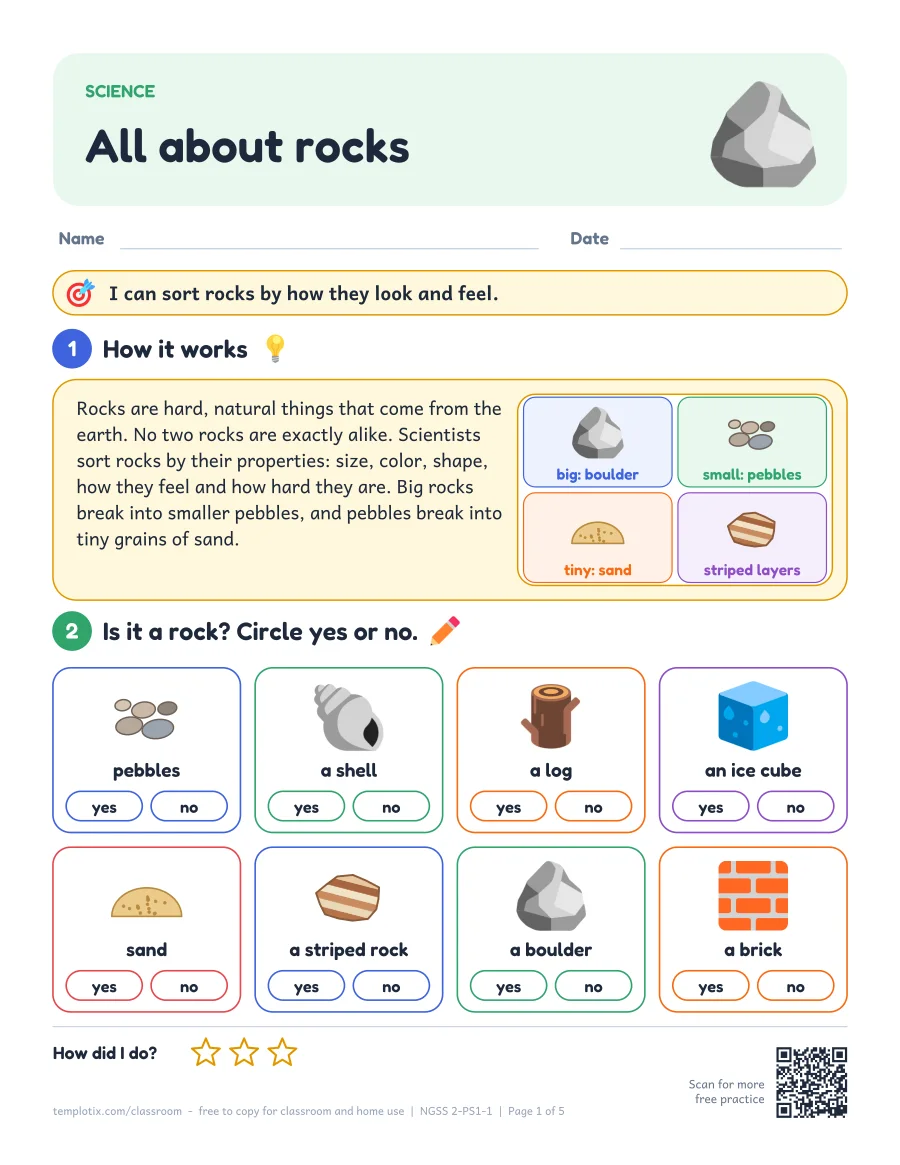
- All about rocks1st and 2nd grade · NGSS 2-PS1-1
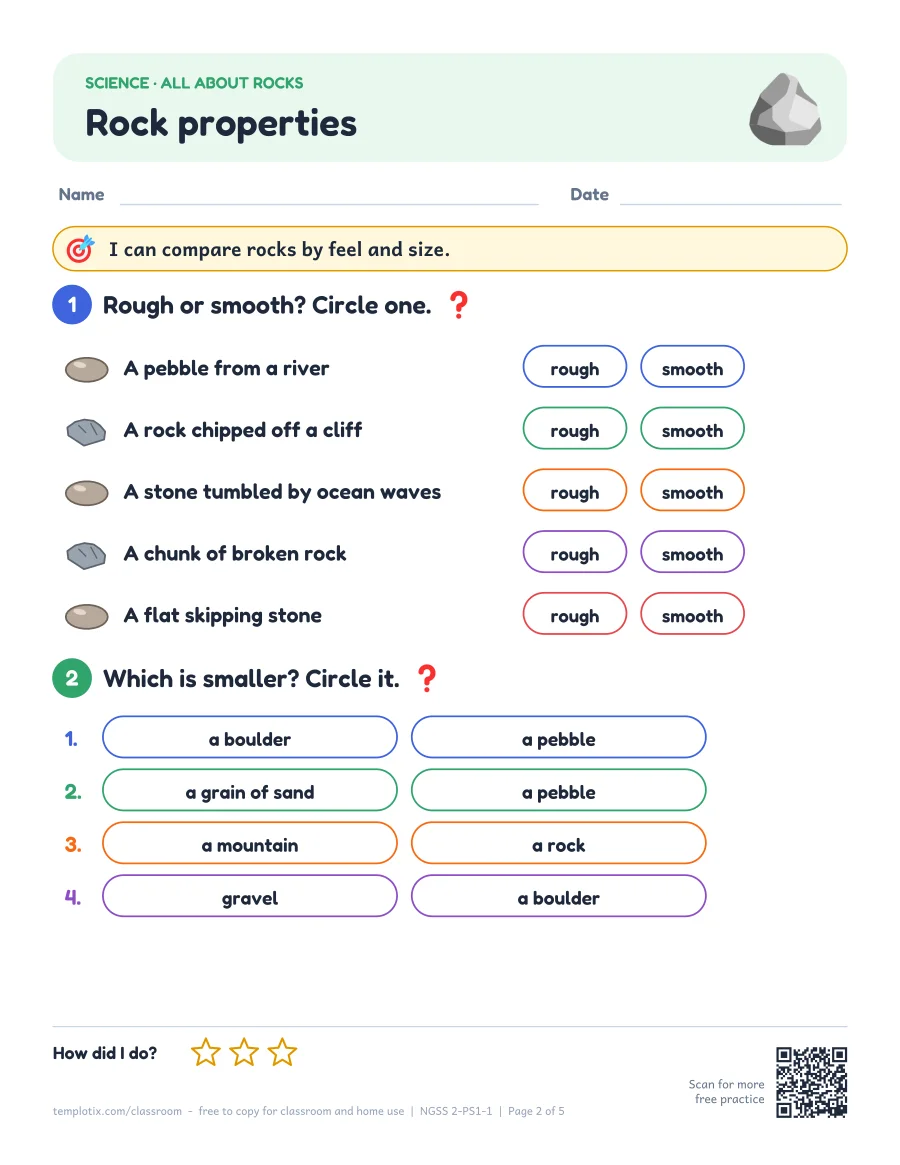
Rocks are hard, natural things that come from the earth. No two rocks are exactly alike. Scientists sort rocks by their properties: size, color, shape, how they feel and how hard they are. Big rocks break into smaller pebbles, and pebbles break into tiny grains of sand.
- What is soil?Kindergarten to 2nd grade · NGSS K-ESS2-2, 2-PS1-1
Soil is the top layer of the ground. It is a mix of tiny bits of rock, bits of old plants and animals, water and air. Worms and bugs dig tunnels that let air and water in. Plants grow their roots in soil, and soil holds the water they drink.
- Land and water2nd grade · NGSS 2-ESS2-2
Earth has many shapes of land and many bodies of water. A mountain is very high land with a peak. A hill is lower and rounder. A valley is low land between hills or mountains. A plain is wide, flat land. An island has water all around it. Rivers flow into lakes and oceans.
- Water on Earth2nd grade · NGSS 2-ESS2-3
Water covers most of Earth. Most of it is salty ocean water. Fresh water is in rivers, lakes, ponds and under the ground. Some water is frozen as solid ice and snow, near the North and South Poles and on high mountains. Water can be a liquid or a solid.
- Weathering and erosion2nd to 4th grade · NGSS 2-ESS2-1, 4-ESS2-1
Weathering breaks rock into smaller pieces. Erosion carries the pieces away. Water, wind and ice are the big movers: rivers carve valleys, waves wear down cliffs, wind blows sand and glaciers scrape the land. It is usually slow, and plants, walls and fences can slow it down even more.
- Fast and slow Earth changes2nd grade · NGSS 2-ESS1-1
Earth's surface is always changing. Some changes are fast and happen in minutes or days: a volcano erupts, an earthquake shakes the ground, or a flood or a landslide moves mud and rocks. Other changes are very slow and take thousands of years, like a river carving a canyon.




Landforms poster
 Landforms poster
One colorful page with eight kinds of land and water (mountain, hill, valley, plain, island, river, lake and ocean), each with a picture and a one-line meaning. Made for a science wall.
What is in each pack
- 1. Learn itA short explanation with a clear, labeled picture, then a first activity.
- 2. PracticeLabeling, matching, sorting and fill in the blanks.
- 3. Think like a scientistWhy questions, true or false and a drawing that explains an idea.
- 4. Try it!A hands-on experiment with a materials list, a prediction and an observation chart.
- 5. Answer keyEvery answer, what to expect from the experiment, a teaching tip and a safety note.


How to teach Earth's surface
- Bring the outside in. A bag of rocks, a cup of soil and a handful of sand turn every page into something children can touch.
- Go on a walk. Look for erosion on the playground: bare patches, muddy runoff, cracked sidewalks and roots holding the soil.
- Use a tray model. Sand, soil and a cup of water on a tray show in minutes what rivers and rain do over years.
- Talk about time. Ask: did this happen in a day or over a very long time? Fast and slow changes come up in every topic.
- Find it on a map. Point out real mountains, rivers, lakes and islands on a map or globe, starting with ones near home.
More science
Common questions
Are these Earth's surface worksheets free?
Yes. Every Earth's surface pack and the poster are free to download, print and copy for your class or home, in color or in a black-and-white ink saver.
What grade are these Earth science worksheets for?
Kindergarten to 4th grade. Soil starts in kindergarten, rocks suit 1st and 2nd grade, land and water, water on Earth and fast and slow changes are 2nd grade topics, and weathering and erosion runs from 2nd to 4th grade in the Next Generation Science Standards (NGSS).
Do I need special supplies for the experiments?
No. The Try it! pages use everyday things, such as a few rocks, a jar of soil, play dough, salt, a tray and some sand. A grown-up handles the glass jar and pokes holes in a cup.
Do the worksheets follow the NGSS?
Yes. Each pack names the NGSS performance expectation it supports, for example 2-ESS2-2 for land and water and 4-ESS2-1 for weathering and erosion.