Shop
 Grade workbooks


Classroom · Science · Matter · 1st and 2nd grade

Properties of matter worksheets
A free five-page science pack for 1st and 2nd grade: learn to describe objects by their properties, with a labeled picture, practice pages, a hands-on experiment and an answer key.
The big idea
 The big idea
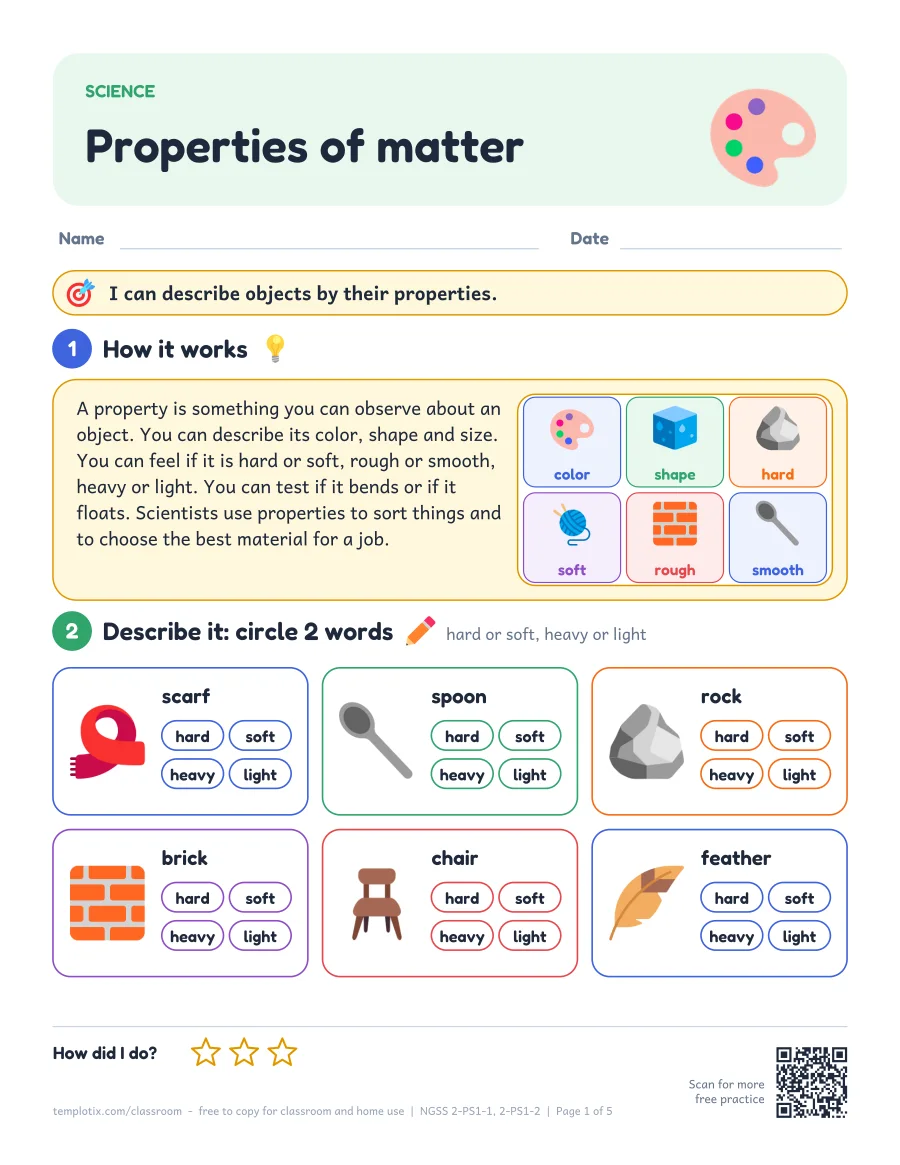
A property is something you can observe about an object. You can describe its color, shape and size. You can feel if it is hard or soft, rough or smooth, heavy or light. You can test if it bends or if it floats. Scientists use properties to sort things and to choose the best material for a job.
Teaching tip
 Teaching tip
Run a property hunt: give each child a word card (hard, soft, rough, smooth or bendy) and five minutes to find something in the room that matches it.
Try it: the mystery bag
 Try it: the mystery bag
I can name objects by feeling their properties.
You need
- A bag or a box
- 6 small objects
- A scarf for a blindfold
- A partner
- A pencil
What to do
- 1A partner hides 6 small objects in the bag, like a spoon, a sponge, a coin and a block.
- 2Reach in without looking. Feel one object.
- 3Say 2 properties: is it hard or soft? Rough or smooth? What shape?
- 4Guess the object, then pull it out to check.
Predict first: Which object will be easiest to guess by touch?What happens?
Answers will vary. Objects with a special shape or texture, like a spoon or a sponge, are the easiest to guess by touch. Smooth, round things are harder. Touch tells us properties like hard, soft, rough, smooth and shape, but not color, which needs our eyes.
Safety: put no sharp or breakable objects in the bag.
Quick check
What is a property?Tap to checkSomething you can observe about an object
Is a rock hard or soft?Tap to checkHard
Is a feather heavy or light?Tap to checkLight
Why are windows made of glass?Tap to checkYou can see through glass
Name a soft material.Tap to checkCotton, wool or a sponge
Does a sock bend?Tap to checkYes
What the worksheets look like
States of matter poster
 States of matter poster
One colorful page showing solids, liquids and gases, how their tiny particles are packed, and everyday examples of each. Made for a science wall.
Common questions
What are examples of properties of matter?
Color, shape, size, texture, hardness, weight, and whether something bends, stretches or floats. Children describe properties with their senses and with simple tools like a ruler or a scale.
Why is it useful to know an object's properties?
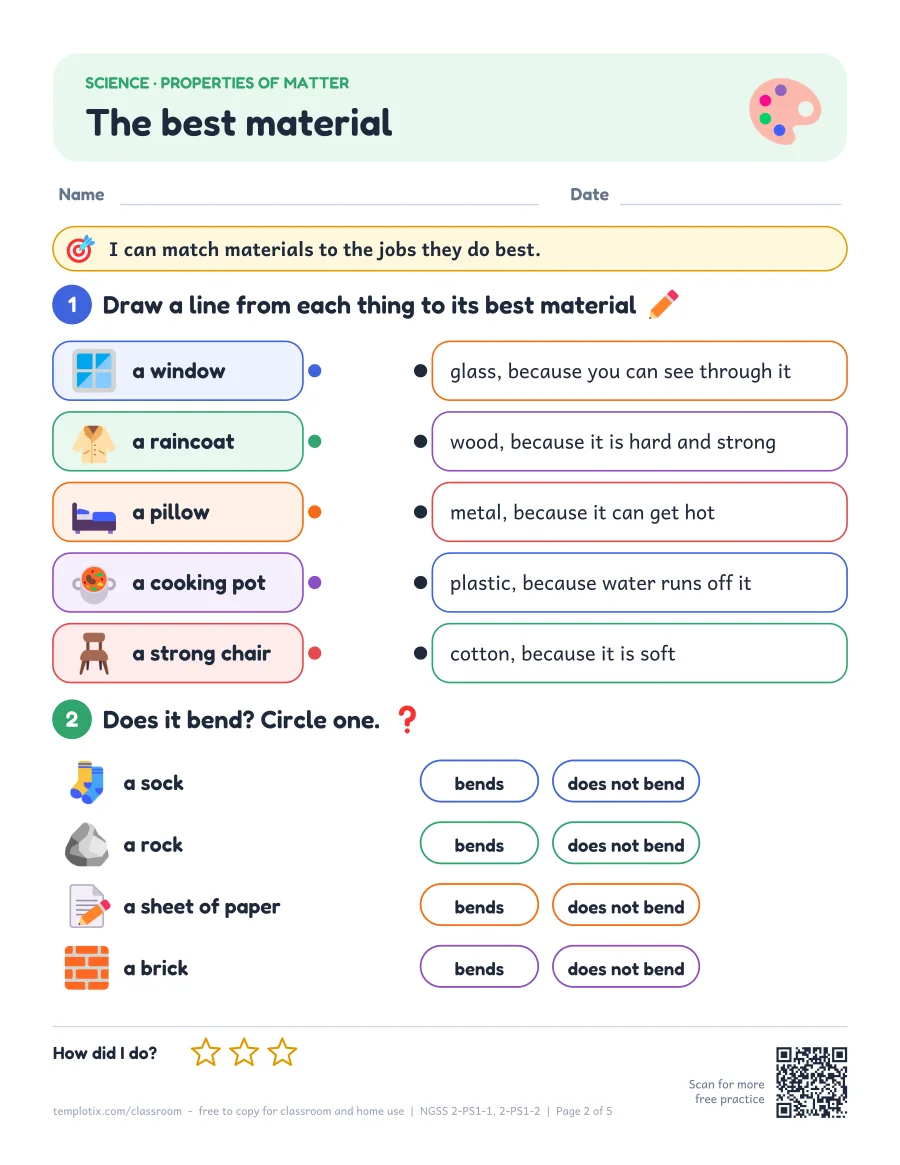
Properties tell us what a material is good for. Glass is clear, so we use it for windows. Rubber stretches and bends, so it is good for boots and balls. Choosing the right material is how engineers design things.
What grade learns properties of matter?
Usually 1st and 2nd grade. In the Next Generation Science Standards (NGSS) it supports 2-PS1-1 and 2-PS1-2.
Is there a hands-on experiment?
Yes. Page 4 is a Try it! experiment, the mystery bag, with a materials list, a prediction and an observation chart. Safety: put no sharp or breakable objects in the bag.
Is there an answer key?
Yes. Page 5 has every answer from the pack, what to expect from the experiment and a short teaching tip.