Shop
 Grade workbooks


Classroom · Science · NGSS K-LS1, 1-LS1, 1-LS3, 2-LS4, 3-LS1, 3-LS2, 3-LS4
worksheets for kindergarten to 3rd grade
Children love animals, so they make science easy to start. Each free pack teaches one big idea, from what animals need to how they survive, with a clear picture, practice pages, a Think like a scientist page and a hands-on experiment, then ends with an answer key.
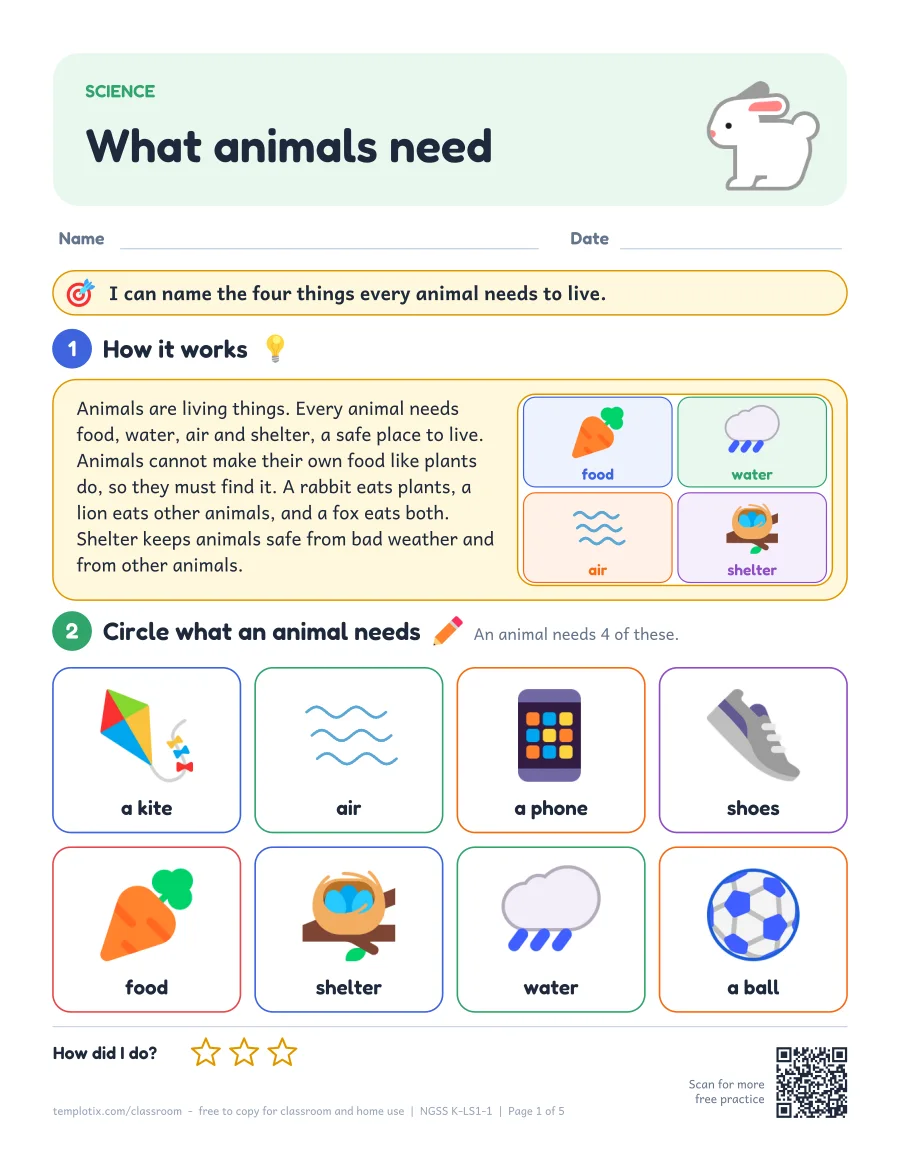
- What animals needKindergarten and 1st grade · NGSS K-LS1-1
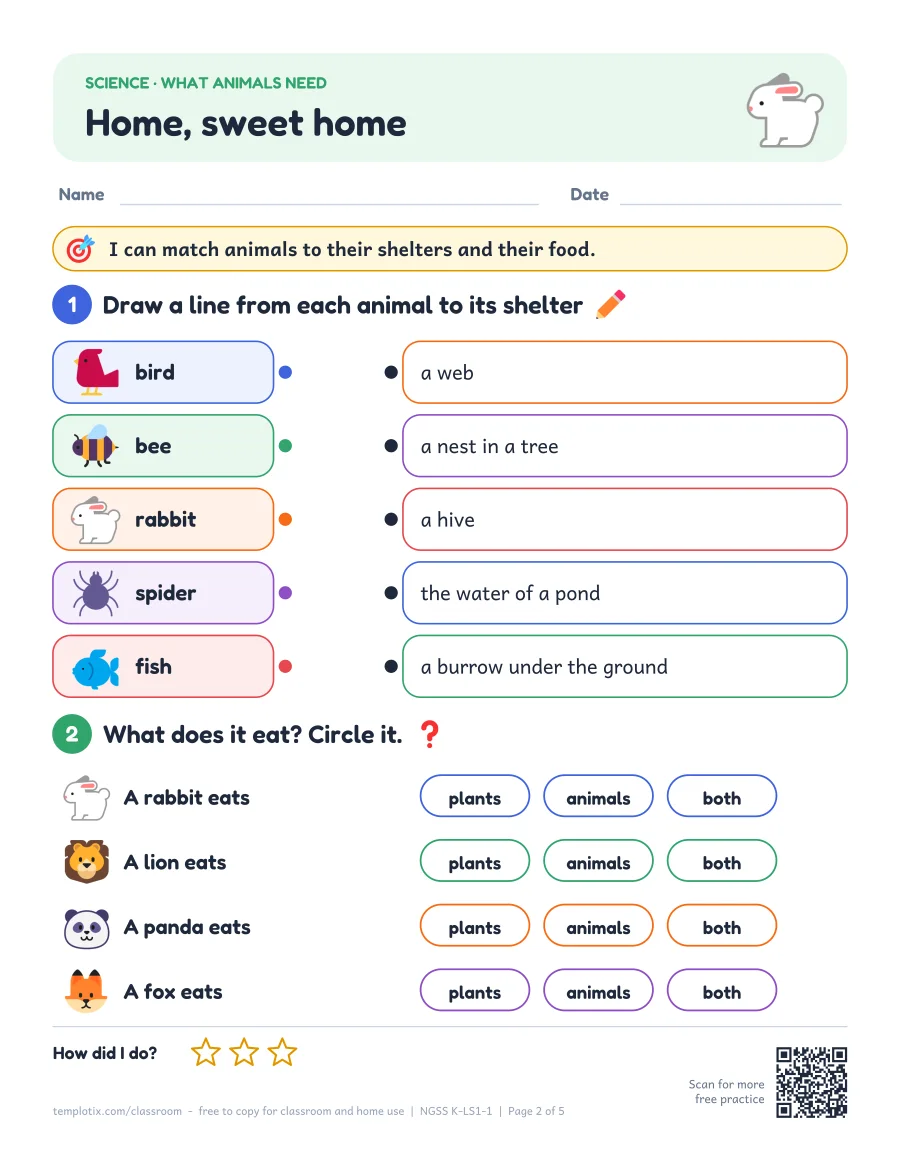
Animals are living things. Every animal needs food, water, air and shelter, a safe place to live. Animals cannot make their own food like plants do, so they must find it. A rabbit eats plants, a lion eats other animals, and a fox eats both. Shelter keeps animals safe from bad weather and from other animals.
- Animals and their babiesKindergarten and 1st grade · NGSS 1-LS1-2, 1-LS3-1
Baby animals look like their parents, but not exactly. A puppy grows into a dog and a kitten grows into a cat. Some babies look very different at first: a tadpole grows into a frog. Many parents help their babies live. They feed them, keep them warm and keep them safe, like a mother bird bringing food to her chicks.
- Animal body parts1st and 2nd grade · NGSS 1-LS1-1
Animals have body parts that help them live. Wings help birds fly. Fins and a tail help fish swim. Sharp claws help a tiger grab its food. A turtle's hard shell keeps it safe, and thick wool keeps a sheep warm. Beaks come in many shapes, each one made for a different food. Every body part has a job.
- Animal habitats2nd and 3rd grade · NGSS 2-LS4-1, 3-LS4-3
A habitat is the place where an animal lives. It gives the animal food, water and shelter. Camels and snakes live in the hot, dry desert. Penguins and seals live in icy polar lands. Whales and sharks live in the ocean. Monkeys live in the rainforest, frogs live in ponds, and owls live in forests.
- Animal life cycles2nd and 3rd grade · NGSS 3-LS1-1
Every animal has a life cycle: it is born, grows, has young and dies. A chick hatches from an egg and grows into a hen. A butterfly changes a lot: egg, caterpillar, chrysalis, butterfly. A frog changes too: egg, tadpole, froglet, frog. A big change like this is called metamorphosis. Then adults lay eggs and the cycle starts again.
- How animals survive3rd grade · NGSS 3-LS2-1, 3-LS4-3
Animals have clever ways to survive. Camouflage lets them hide: a snowy owl blends into the snow. Some animals migrate, moving to warmer places in winter, like geese and whales. Some hibernate, sleeping through the cold, like bats. Many live in groups: zebras in a herd and fish in a school stay safer together.





Animal habitats poster
 Animal habitats poster
One colorful page with six habitats (ocean, desert, polar lands, rainforest, pond and forest) and three animals that live in each. Made for a science wall.
What is in each pack
- 1. Learn itA short explanation with a clear, labeled picture, then a first activity.
- 2. PracticeLabeling, matching, sorting and fill in the blanks.
- 3. Think like a scientistWhy questions, true or false and a drawing that explains an idea.
- 4. Try it!A hands-on experiment with a materials list, a prediction and an observation chart.
- 5. Answer keyEvery answer, what to expect from the experiment, a teaching tip and a safety note.


How to teach animals
- Start with a real animal. A class pet, a bird at the window or ants on the playground make every page more real than a picture.
- Ask what it needs. Food, water, air and shelter come up in every topic, from habitats to survival, so keep coming back to them.
- Compare two animals. How is a duck like a fish? How is it different? Comparing makes children look closely at body parts and habitats.
- Act it out. Hop like a kangaroo, waddle like a penguin, hide like a moth. Moving helps young children remember.
- Use evidence words. When children answer, ask what they saw that tells them so. Scientists back up their answers.
More science
Common questions
Are these animal worksheets free?
Yes. Every animal pack and the poster are free to download, print and copy for your class or home, in color or in a black-and-white ink saver.
What grade are these animal worksheets for?
Kindergarten to 3rd grade. What animals need and animal babies start in kindergarten, body parts suit 1st and 2nd grade, and habitats, life cycles and survival are 2nd and 3rd grade topics in the Next Generation Science Standards (NGSS).
Do I need special supplies for the experiments?
No. Every Try it! page uses everyday things, such as a paper plate, a spoon, a straw, dry pasta or old newspaper. The outdoor activities need a grown-up nearby.
Do the worksheets follow the NGSS?
Yes. Each pack names the NGSS performance expectation it supports, for example K-LS1-1 for what animals need and 3-LS1-1 for animal life cycles.