Shop
 Grade workbooks


Classroom · Science · Ecosystems and food chains · 3rd and 4th grade

Predators and prey worksheets
A free five-page science pack for 3rd and 4th grade: learn to explain how predators and prey are built to survive, with a labeled picture, practice pages, a hands-on experiment and an answer key.
The big idea
 The big idea
A predator is an animal that hunts other animals for food, like an owl or a shark. Prey is the animal that gets hunted, like a mouse or a fish. Both have body parts that help them: predators have sharp claws and teeth and eyes that face forward, while prey animals have eyes on the sides, fast legs and colors that help them hide.
Teaching tip
 Teaching tip
Point out that one animal can be both. A frog is a predator to flies and prey to a snake, which keeps children from sorting animals into good and bad.
Try it: the burrow game
 Try it: the burrow game
I can test how shelter helps prey survive.
You need
- A big open space
- Hoops or chalk circles for burrows
- A timer
- A group of friends
- A pencil and paper
What to do
- 1One player is the fox. Everyone else is a rabbit.
- 2Rabbits are safe inside a burrow, but only for 5 seconds at a time.
- 3Play for 1 minute with 1 burrow and count the rabbits tagged. Then play with 3 burrows and with 5.
- 4Compare the rounds.
Predict first: Will more rabbits be tagged with 1 burrow or with 5?What happens?
With only 1 burrow, the fox tags many rabbits. With 5 burrows, most rabbits stay safe. Shelter helps prey survive, which is why rabbits live near burrows, fish hide in reeds and mice stay under logs. When a habitat loses its shelter, prey animals are in more danger.
Safety: play on soft grass, tag gently and watch where you run.
Quick check
What is a predator?Tap to checkAn animal that hunts other animals for food
What is prey?Tap to checkAn animal that is hunted
Name a predator.Tap to checkAn owl, a lion, a shark or a wolf
Name a prey animal.Tap to checkA mouse, a rabbit, a zebra or a fish
Can an animal be both?Tap to checkYes, a frog is both
How do side eyes help prey?Tap to checkThey can see almost all the way around
What the worksheets look like
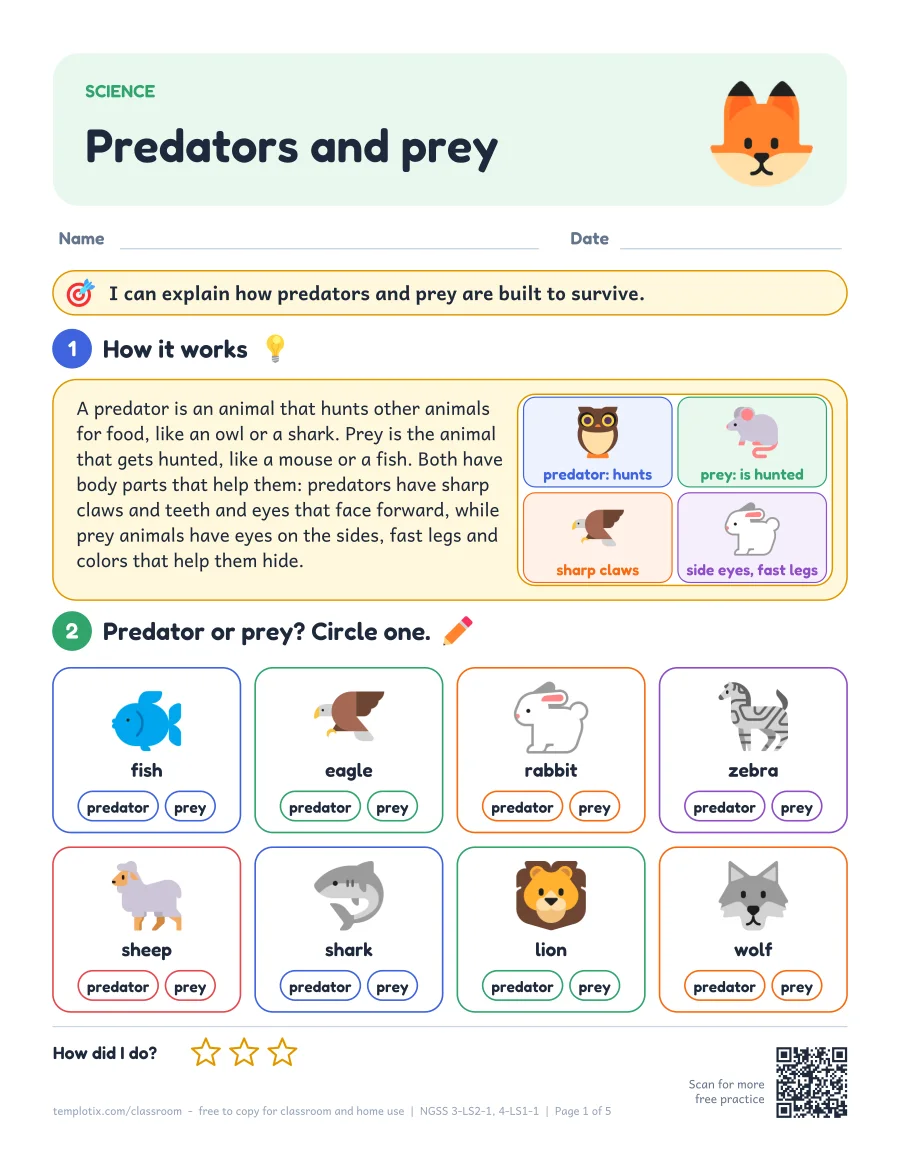
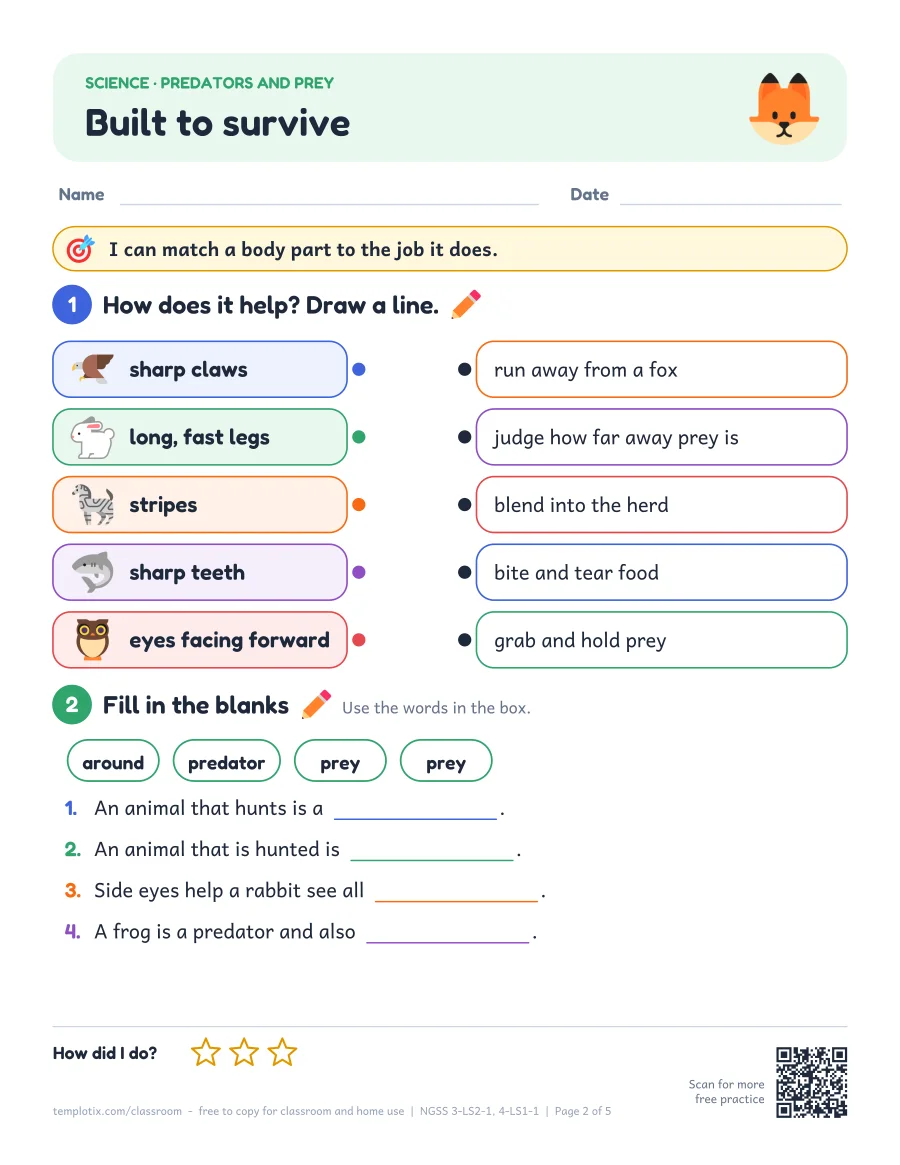
Who eats what? poster
 Who eats what? poster
One colorful page with a food chain, producers, consumers, decomposers, predators, prey and food webs, each with a picture and a one-line meaning. Made for a science wall.
Common questions
Can an animal be both a predator and prey?
Yes. A frog hunts insects, so it is a predator, but snakes and birds hunt frogs, so it is also prey. Most animals in the middle of a food chain are both.
Why do many prey animals have eyes on the sides of their heads?
Side eyes let animals like rabbits and deer see almost all the way around them, so they can spot a predator coming. Predators usually have eyes facing forward to judge distance when they pounce.
What grade learns predators and prey?
Usually 3rd and 4th grade. In the Next Generation Science Standards (NGSS) it supports 3-LS2-1 and 4-LS1-1.
Is there a hands-on experiment?
Yes. Page 4 is a Try it! experiment, the burrow game, with a materials list, a prediction and an observation chart. Safety: play on soft grass, tag gently and watch where you run.
Is there an answer key?
Yes. Page 5 has every answer from the pack, what to expect from the experiment and a short teaching tip.