Shop
 Grade workbooks


Classroom · Math · CCSS K.MD.B.3, 2.OA.C.3, 3.OA.D.9, 4.OA.C.5
worksheets for kindergarten to 4th grade
Continue picture and shape patterns, name AB, ABB and ABC patterns, grow square patterns step by step, find number pattern rules, fill in input and output tables and describe patterns made from a rule. Patterns build the thinking that later becomes algebra.
- Picture patternsKindergarten
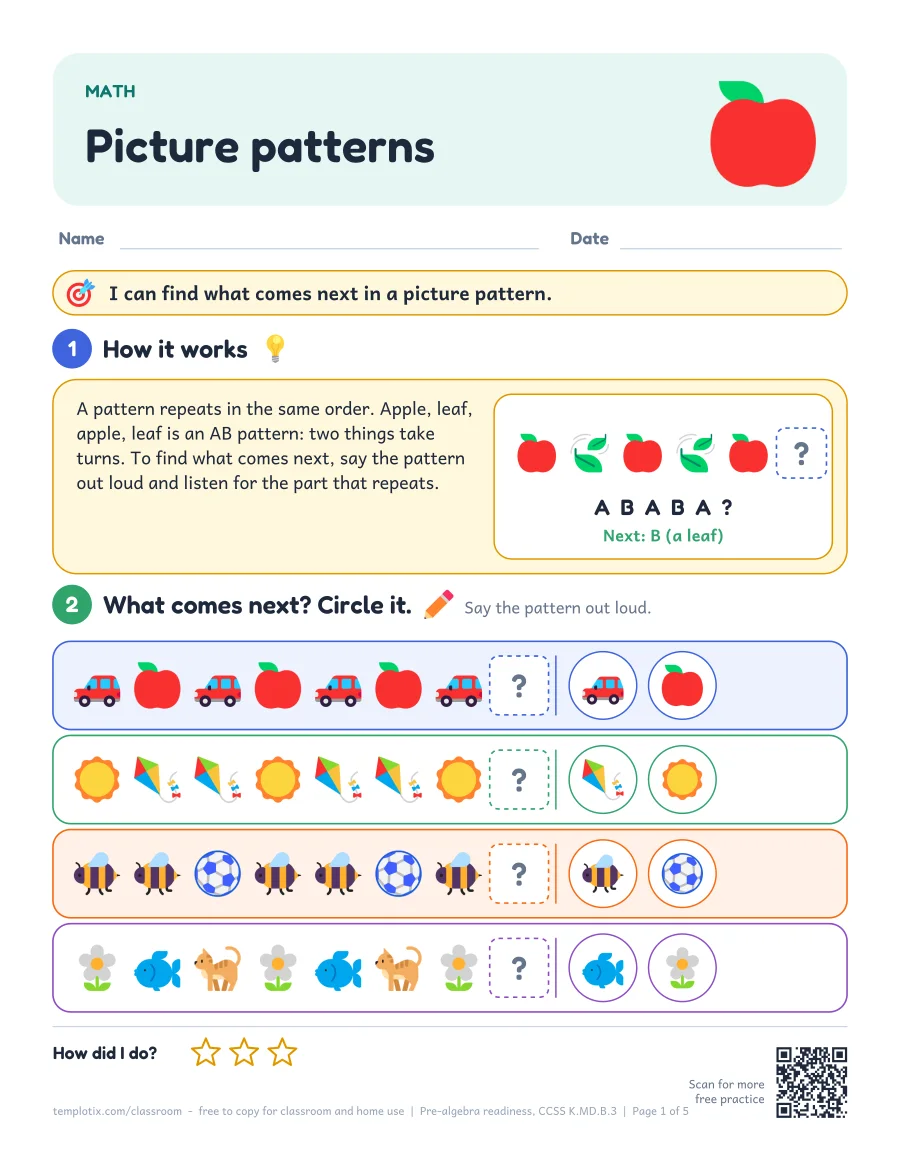
A pattern repeats in the same order. Apple, leaf, apple, leaf is an AB pattern: two things take turns. To find what comes next, say the pattern out loud and listen for the part that repeats.
- Shape patternsKindergarten and 1st grade
In a shape pattern, a group of shapes repeats. The part that repeats is the core. Circle, square, triangle is an ABC core. Find the core, then keep going in the same order.
- Growing patterns1st and 2nd grade
In a growing pattern each step gets bigger. A tower pattern has 2 squares in step 1, 4 in step 2 and 6 in step 3. It adds 2 squares each time, so step 4 has 8. Look at what is added to find the next step.
- Number patterns2nd and 3rd grade
A number pattern follows a rule. In 4, 7, 10, 13 each number is 3 more than the one before, so the rule is add 3 and the next number is 16. Find the difference between neighbors to find the rule.
- Input and output tables3rd and 4th grade
An input and output table shows a rule at work. A number goes In, the rule changes it, and a number comes Out. With the rule × 3, 2 goes in and 6 comes out. To find a rule, test +, – and × on the first row, then check it works for every row.
- Pattern rules4th grade
A rule like "start at 3, add 4" makes the pattern 3, 7, 11, 15, 19. You can notice features the rule does not say: here every number is odd, because adding an even number to an odd number always gives an odd number. Two patterns can also be compared.






Kinds of patterns poster
 Kinds of patterns poster
Repeating, growing, number and input-output patterns on one page.
Whole unit in one PDF Plus
 Whole unit in one PDF
All patterns packs, the unit chart and a contents page: 32 pages, ready to print. For Templotix Plus members.
What is in each pack
- 1. Learn itThe idea with a picture, then first practice.
- 2. PracticeFinish patterns, complete tables or find missing numbers.
- 3. Think deeperFind the mistake, predict far ahead and make your own pattern.
- 4. Word problemsFour short stories with a pattern inside.
- 5. Answer key and tipEvery answer on one page, plus a teaching tip for grown-ups.


How to teach patterns
- Say it out loud. Children read patterns aloud ("apple, leaf, apple, leaf"). Hearing the rhythm makes the next item obvious.
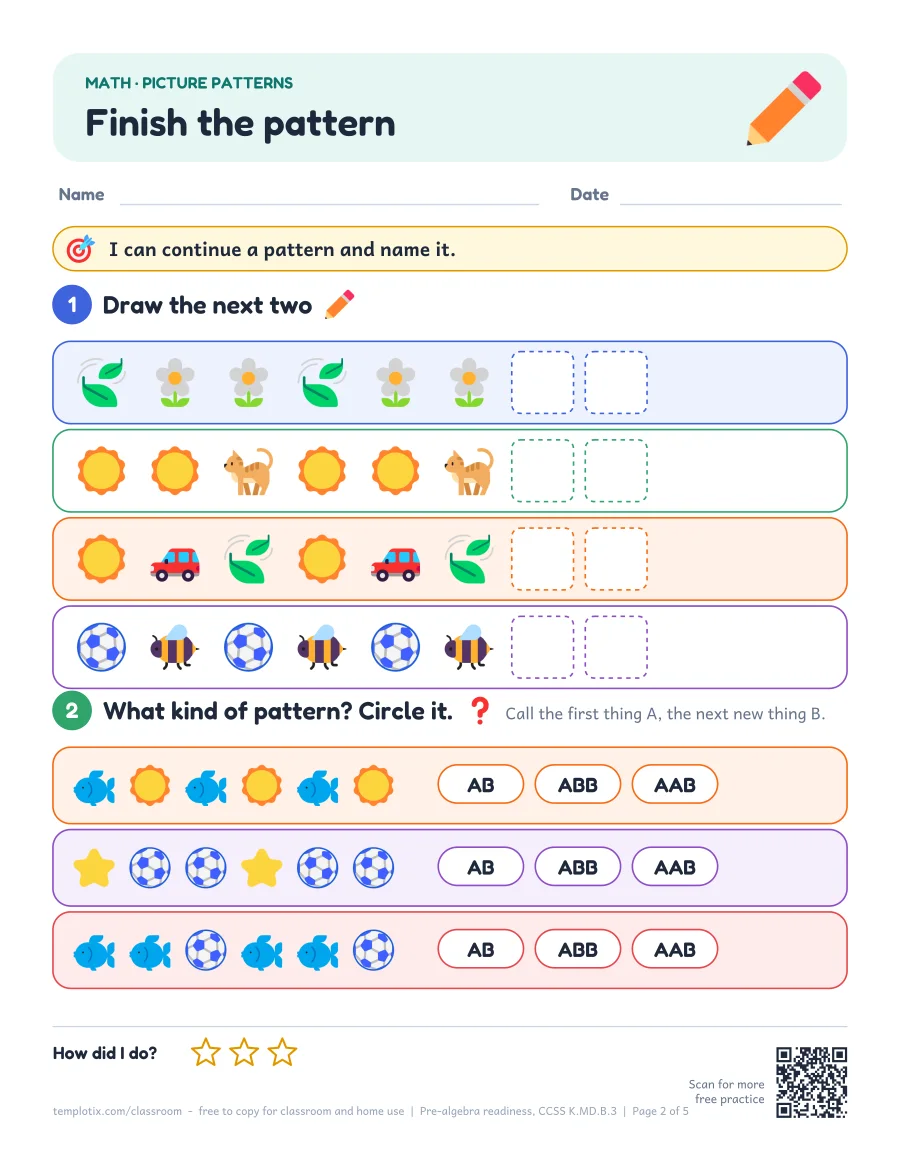
- Find the core. Before continuing a repeating pattern, circle the part that repeats.
- Build it. Use blocks or counters to build growing patterns before counting them on paper.
- Check every step. For number rules and tables, test the rule on every pair, not just the first one.
More math
- Telling time
- Money
- Fractions
- Division
- Multi-digit multiplication
- Decimals
- Greater than and less than
- Skip counting
- Shapes
- Number bonds
- Graphs and data
- Measurement
- Area and Perimeter
- Rounding and Estimating
- 3-Digit Addition and Subtraction
- Factors and Multiples
- Fraction Operations
- Decimal Operations
- Math Word Problems
- Geometry
- Order of Operations
- Measurement Conversions
- Counting
- Multiplication Strategies
- Multi-Digit Place Value
Common questions
What is a pattern in math?
A pattern is something that repeats or changes in a predictable way. A repeating pattern has a core that repeats, like circle, square, circle, square. A growing pattern gets bigger by the same rule each step, and a number pattern follows a rule like add 5.
What are AB, ABB and ABC patterns?
The letters name the core of a repeating pattern. In an AB pattern two things take turns (apple, leaf, apple, leaf). In ABB one thing is followed by two of another. In ABC three different things repeat in order.
What grade learns number patterns and input-output tables?
Young children copy and extend repeating patterns in preschool and kindergarten. Number patterns appear in 2nd and 3rd grade (CCSS 3.OA.D.9), and making patterns from a rule and noticing their features is a 4th grade standard (CCSS 4.OA.C.5).
Can I copy these worksheets for my class?
Yes. The PDFs are free to print and photocopy for classroom and home use, in color or in the black-and-white ink saver. Please link to this page rather than re-uploading the files.