Shop
 Grade workbooks


Classroom · Science · Space · Kindergarten and 1st grade

Light and shadows worksheets
A free five-page science pack for Kindergarten and 1st grade: learn to explain how shadows are made, with a labeled picture, practice pages, a hands-on experiment and an answer key.
The big idea
 The big idea
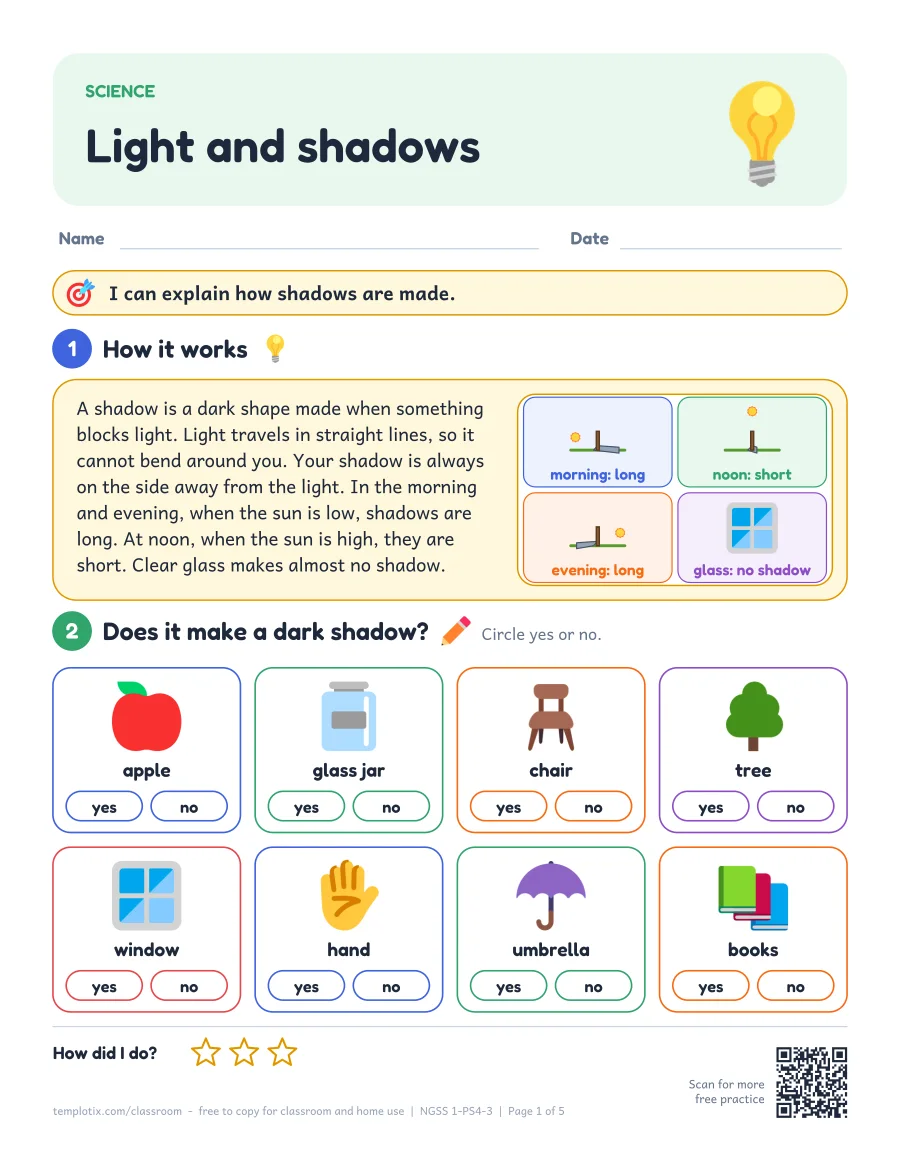
A shadow is a dark shape made when something blocks light. Light travels in straight lines, so it cannot bend around you. Your shadow is always on the side away from the light. In the morning and evening, when the sun is low, shadows are long. At noon, when the sun is high, they are short. Clear glass makes almost no shadow.
Teaching tip
 Teaching tip
Play shadow tag outside on a sunny morning, then again at noon. Children notice right away that long morning shadows are much easier to step on.
Try it: shadow tracing
 Try it: shadow tracing
I can observe how a shadow changes during the day.
You need
- Sidewalk chalk
- A sunny spot
- A toy that stands up
- A clock
- A partner
What to do
- 1Stand the toy on the ground in a sunny spot. Mark where it stands.
- 2Trace its shadow with chalk in the morning. Write the time.
- 3Trace it again at noon and in the afternoon, without moving the toy.
- 4Compare the three shadows. How did they change?
Predict first: When will the shadow be shortest?What happens?
The morning shadow is long and points away from the sun, toward the west. At noon the shadow is shortest, because the sun is high in the sky. In the afternoon the shadow grows long again and points the other way, toward the east. Shadows move because Earth spins.
Safety: never look straight at the sun. Work outside with a grown-up and wear a hat.
Quick check
How is a shadow made?Tap to checkSomething blocks the light
When is your shadow shortest?Tap to checkAt noon
When is your shadow longest?Tap to checkEarly morning and late afternoon
Does clear glass make a dark shadow?Tap to checkNo, light passes through it
Which way does your shadow point?Tap to checkAway from the light
Can you make a shadow with a flashlight?Tap to checkYes
What the worksheets look like
Solar system poster
 Solar system poster
One colorful page with the sun and the eight planets in order, a fact for each, which are rocky and which are gas giants, and a sentence to remember the order.
Common questions
Why do shadows change during the day?
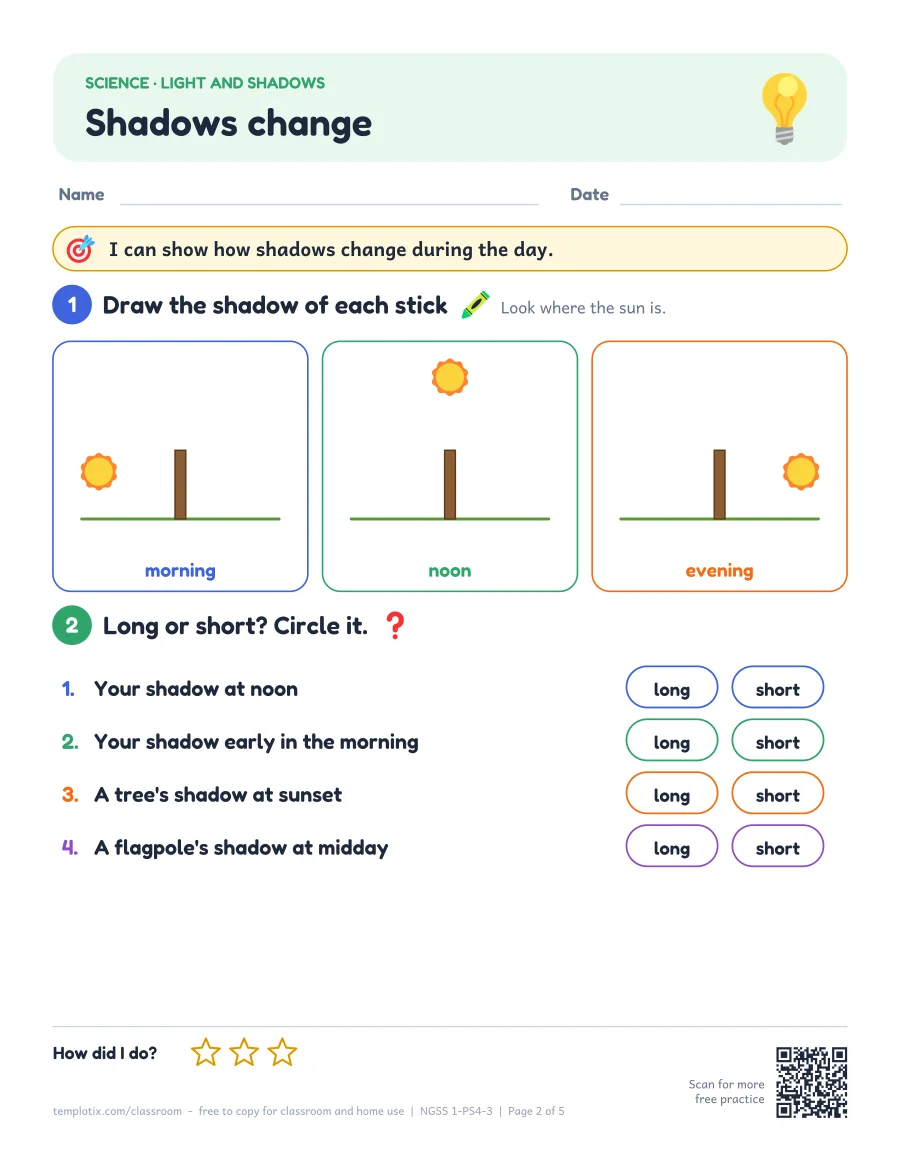
The sun's place in the sky changes as Earth turns. In the morning and evening the sun is low, so shadows are long. Around midday the sun is high, so shadows are short.
What makes a shadow dark or light?
Things that block all light, like wood or your body, make dark shadows. Things that let some light through, like tissue paper or colored plastic, make pale shadows. Clear glass lets almost all light through and makes almost no shadow.
What grade learns light and shadows?
Usually Kindergarten and 1st grade. In the Next Generation Science Standards (NGSS) it supports 1-PS4-3.
Is there a hands-on experiment?
Yes. Page 4 is a Try it! experiment, shadow tracing, with a materials list, a prediction and an observation chart. Safety: never look straight at the sun. Work outside with a grown-up and wear a hat.
Is there an answer key?
Yes. Page 5 has every answer from the pack, what to expect from the experiment and a short teaching tip.