Shop
 Grade workbooks


Classroom · Science · Animals · Kindergarten and 1st grade
Animals and their babies worksheets
A free five-page science pack for Kindergarten and 1st grade: learn to match animal babies to their parents, with a labeled picture, practice pages, a hands-on experiment and an answer key.
The big idea
 The big idea
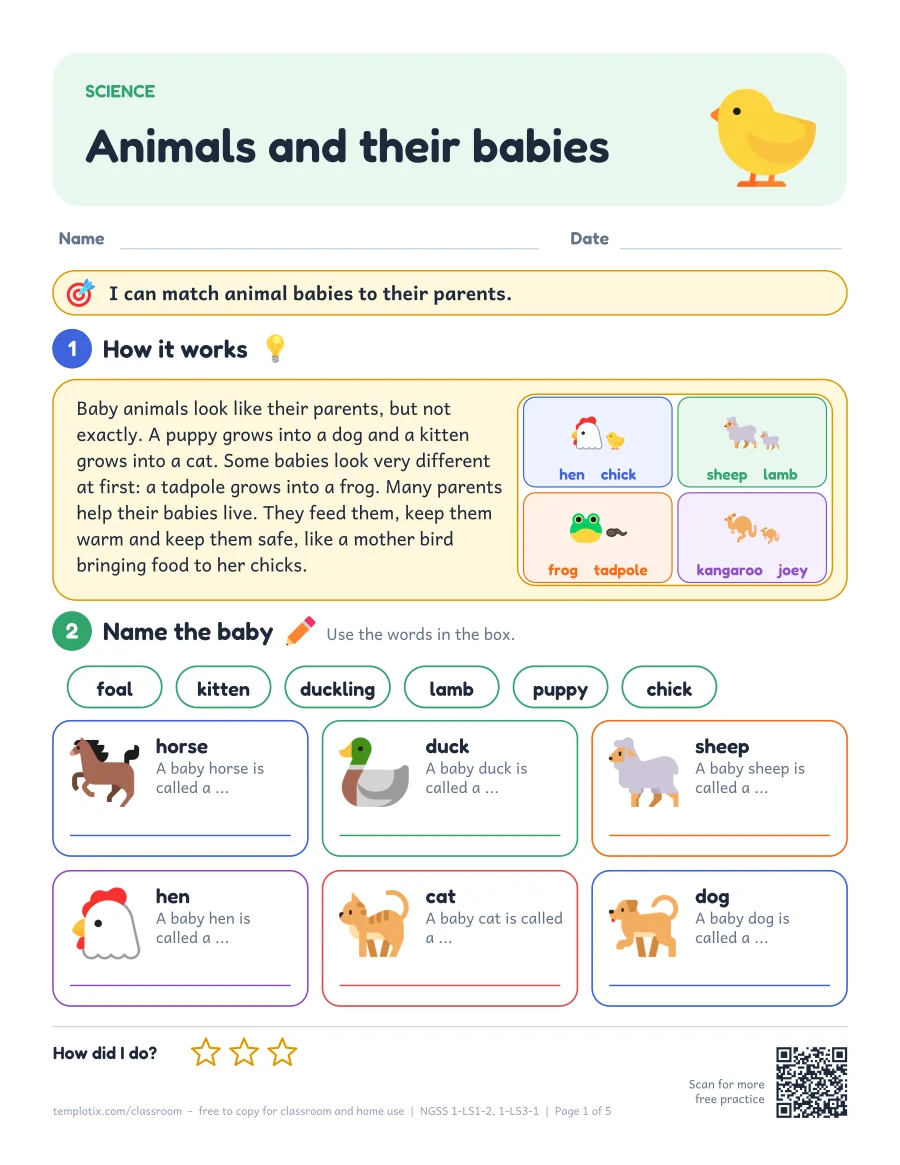
Baby animals look like their parents, but not exactly. A puppy grows into a dog and a kitten grows into a cat. Some babies look very different at first: a tadpole grows into a frog. Many parents help their babies live. They feed them, keep them warm and keep them safe, like a mother bird bringing food to her chicks.
Teaching tip
 Teaching tip
Play a matching game: show a parent card and let children find its baby card. Ask what helped them match, then ask how the baby is different.
Try it: animal family watch
 Try it: animal family watch
I can observe how animal parents help their babies.
You need
- A park or a nature video
- Binoculars, if you have them
- A notebook
- A pencil
- A grown-up
What to do
- 1With a grown-up, watch birds or ducks in a park, or a nature video about animal families.
- 2Find a parent and its baby.
- 3Watch for 10 minutes. Does the parent feed, carry, warm, guard or teach the baby?
- 4Write what you see in the chart, and how it helps the baby.
Predict first: What will the parent do the most?What happens?
Answers will vary. Parents often feed their babies, carry them, keep them warm or chase danger away. Each of these helps the baby stay fed, warm and safe until it can live on its own.
Safety: watch animals from far away. Never touch baby animals or nests, because the parents may be close by.
Quick check
What is a baby hen called?Tap to checkA chick
What is a baby sheep called?Tap to checkA lamb
What is a baby frog called?Tap to checkA tadpole
What is a baby kangaroo called?Tap to checkA joey
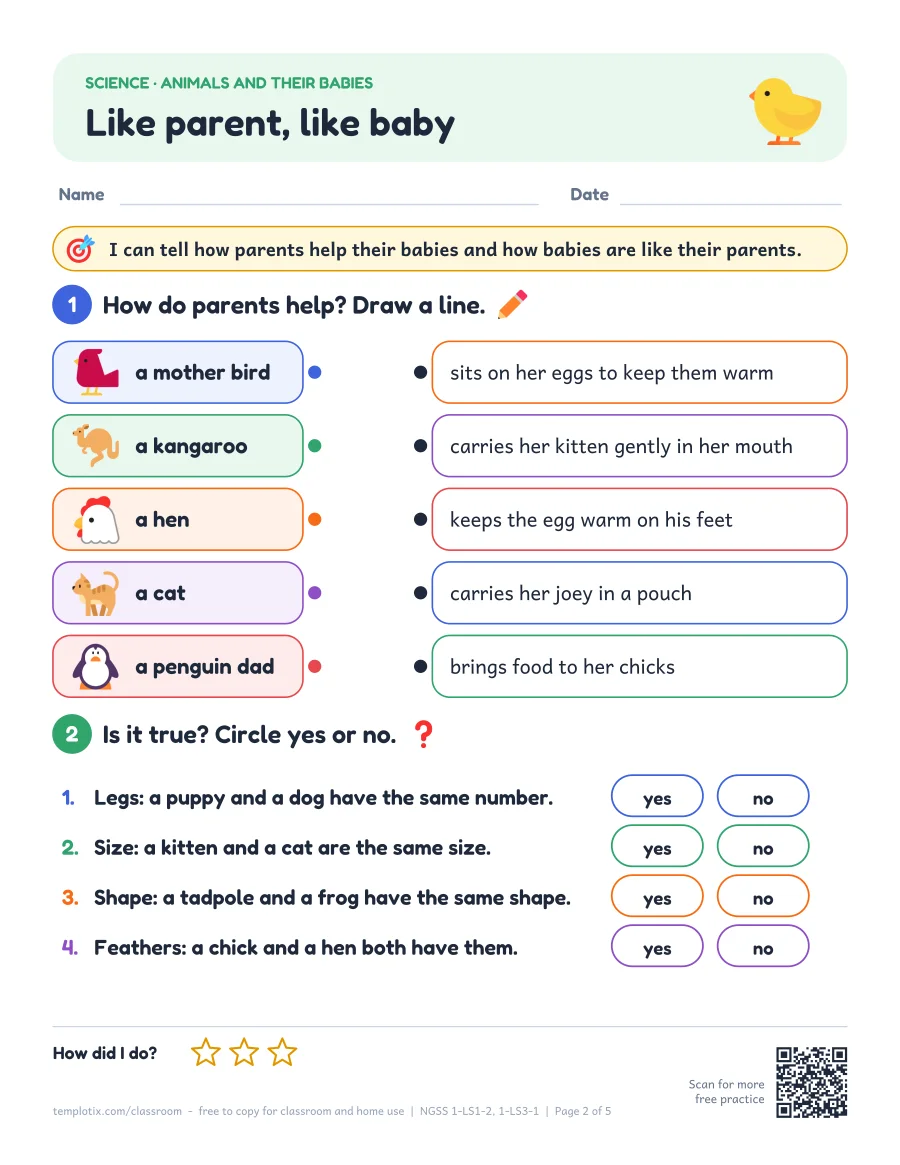
How does a mother bird help her chicks?Tap to checkShe brings them food
How is a kitten different from a cat?Tap to checkIt is smaller
What the worksheets look like
Animal habitats poster
 Animal habitats poster
One colorful page with six habitats (ocean, desert, polar lands, rainforest, pond and forest) and three animals that live in each. Made for a science wall.
Common questions
Which baby animals look different from their parents?
Tadpoles look like little fish before they grow legs and become frogs, and caterpillars look nothing like butterflies. Most mammal babies, such as puppies and foals, look like small copies of their parents.
Do all animals take care of their babies?
No. Birds and mammals feed and protect their young. Many turtles, fish and insects lay eggs and leave, so their babies are on their own from the start. That is one reason they lay so many eggs.
What grade learns animals and their babies?
Usually Kindergarten and 1st grade. In the Next Generation Science Standards (NGSS) it supports 1-LS1-2 and 1-LS3-1.
Is there a hands-on experiment?
Yes. Page 4 is a Try it! experiment, animal family watch, with a materials list, a prediction and an observation chart. Safety: watch animals from far away. Never touch baby animals or nests, because the parents may be close by.
Is there an answer key?
Yes. Page 5 has every answer from the pack, what to expect from the experiment and a short teaching tip.