Shop
 Grade workbooks


Classroom · Factors and Multiples · 4th grade

Prime and composite numbers worksheets
A free five-page pack for 4th grade: learn to tell if a number is prime or composite, with a worked example, practice pages, word problems and an answer key.
How to do it
 How to do it
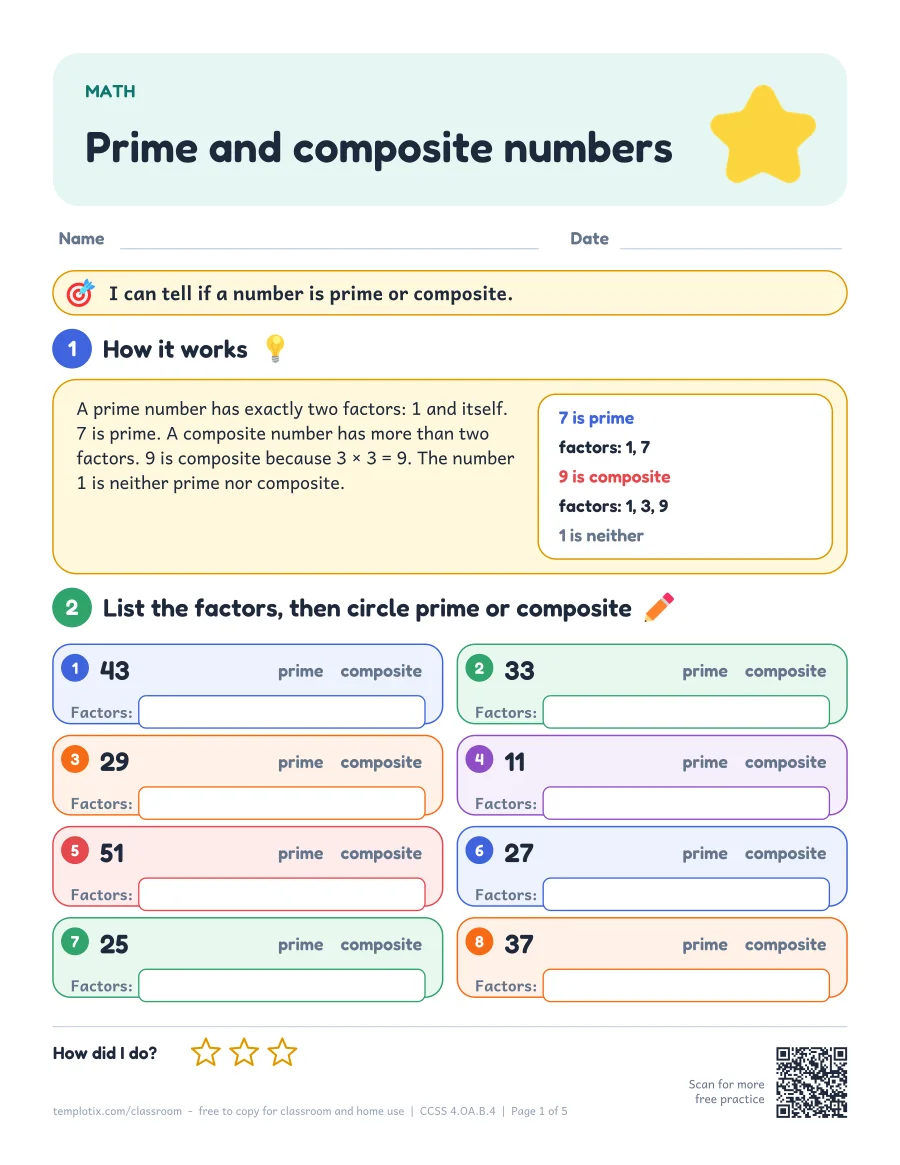
A prime number has exactly two factors: 1 and itself. 7 is prime. A composite number has more than two factors. 9 is composite because 3 × 3 = 9. The number 1 is neither prime nor composite.
Teaching tip
 Teaching tip
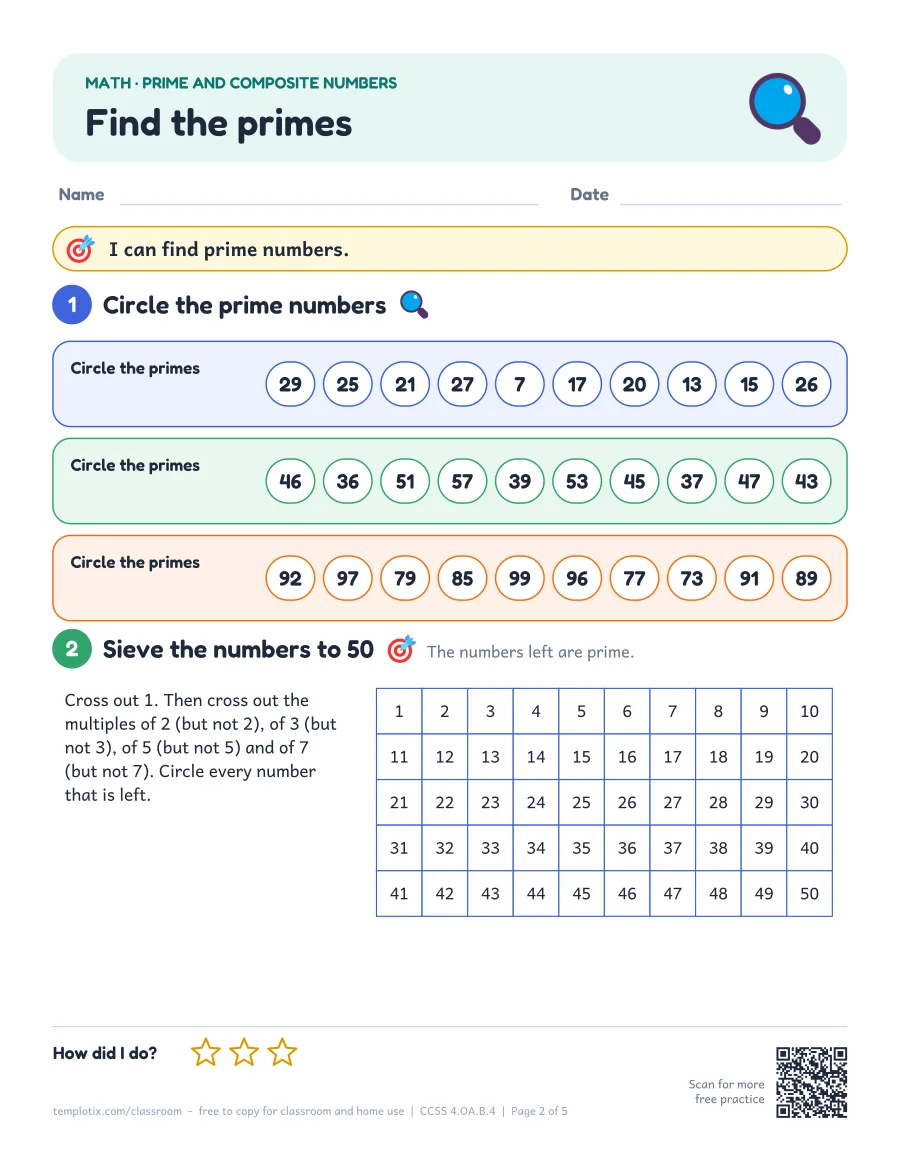
To test a number under 100, try dividing by 2, 3, 5 and 7. If none of them divides it exactly, the number is prime.
Try some
Is 43 prime or composite?Tap to checkPrime (factors: 1, 43)
Is 33 prime or composite?Tap to checkComposite (factors: 1, 3, 11, 33)
Is 29 prime or composite?Tap to checkPrime (factors: 1, 29)
Is 11 prime or composite?Tap to checkPrime (factors: 1, 11)
Is 51 prime or composite?Tap to checkComposite (factors: 1, 3, 17, 51)
Is 27 prime or composite?Tap to checkComposite (factors: 1, 3, 9, 27)
What is the only even prime number?Tap to check2
Is 1 prime or composite?Tap to checkNeither. It has only one factor.
Word problems
Noor has 13 cookies and wants to put them in equal rows. How many different ways can Noor do it? Is 13 prime or composite?Show answer

1 row of 13 or 13 rows of 1. 13 is prime.
A teacher has 21 students. Can she put them in equal groups with more than 1 student and more than 1 group? Is 21 prime or composite?Show answer

Yes, 3 groups of 7 or 7 groups of 3. 21 is composite.
Ben says, "All odd numbers are prime." Find an odd number that shows Ben is wrong.Show answer

Any odd composite number, such as 9, 15, 21 or 25
I am a prime number between 20 and 30. The sum of my digits is 5. What number am I?Show answer
23
What the worksheets look like
Prime numbers chart
 Prime numbers chart
A hundred chart with the 25 prime numbers from 1 to 100 circled.
Common questions
How do you teach prime and composite numbers?
A prime number has exactly two factors: 1 and itself. 7 is prime. A composite number has more than two factors. 9 is composite because 3 × 3 = 9. The number 1 is neither prime nor composite. To test a number under 100, try dividing by 2, 3, 5 and 7. If none of them divides it exactly, the number is prime.
What grade learns prime and composite numbers?
Usually 4th grade. In the Common Core it is part of 4.OA.B.4.
Is there an answer key?
Yes. Page 5 has every answer from the pack and a short teaching tip.