Shop
 Grade workbooks


Classroom · Measurement · 3rd grade

Mass and liquid volume worksheets
A free five-page pack for 3rd grade: learn to measure mass in grams and kilograms and liquid volume in liters, with a worked example, practice pages, word problems and an answer key.
How to do it
 How to do it
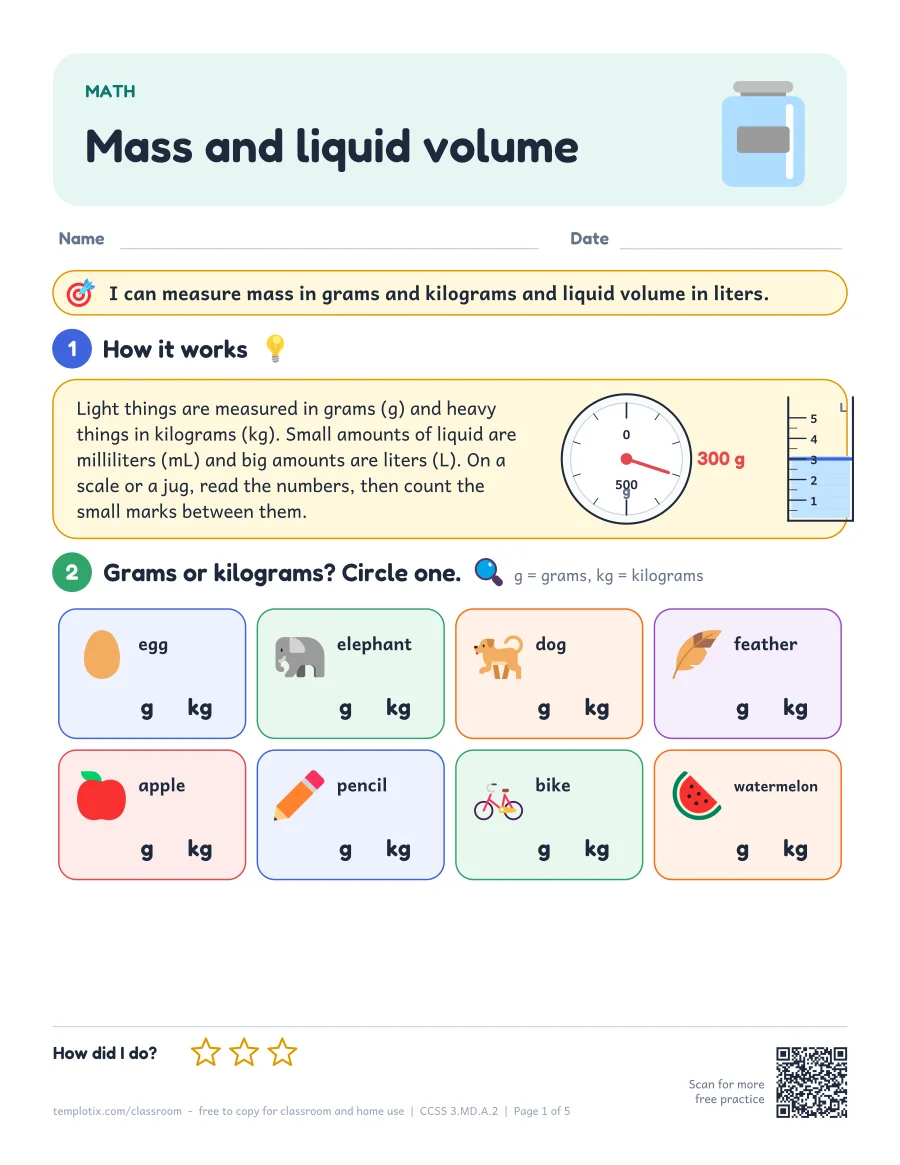
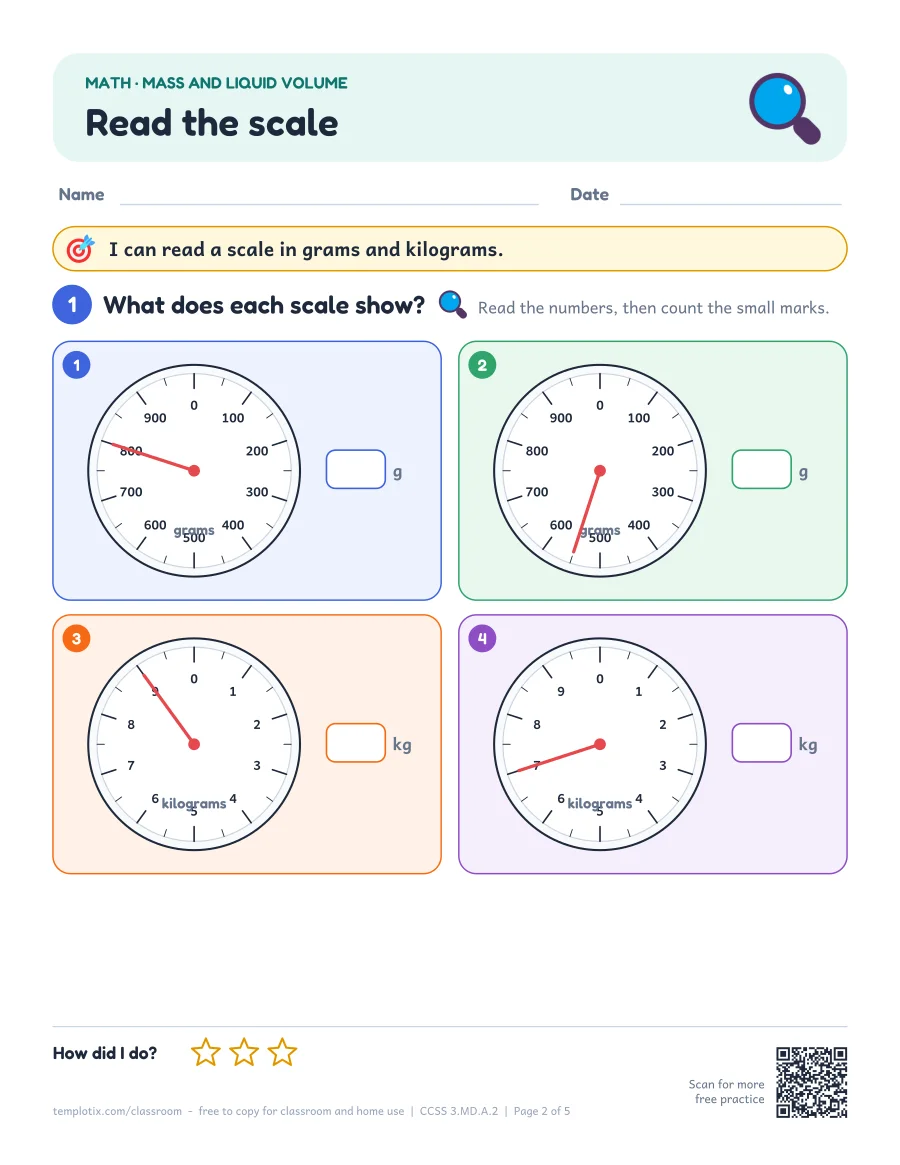
Light things are measured in grams (g) and heavy things in kilograms (kg). Small amounts of liquid are milliliters (mL) and big amounts are liters (L). On a scale or a jug, read the numbers, then count the small marks between them.
Teaching tip
 Teaching tip
Let children hold a 1-kilogram bag of rice or flour and a paper clip (about 1 gram), and fill a 1-liter bottle, so the units feel real.
Try some
Would you measure an egg in grams or kilograms?Tap to checkgrams
Would you measure an elephant in grams or kilograms?Tap to checkkilograms
Would you measure a dog in grams or kilograms?Tap to checkkilograms
Would you measure a feather in grams or kilograms?Tap to checkgrams
Would you measure the water in a bathtub in milliliters or liters?Tap to checkliters
Would you measure the water in a mug in milliliters or liters?Tap to checkmilliliters
A melon is 9 kg and a pumpkin is 7 kg. What is their total mass?Tap to check16 kg
A jug has 850 mL of milk. You drink 100 mL. How much is left?Tap to check750 mL
Word problems
A bag of apples has a mass of 950 grams. A bag of pears has a mass of 600 grams. How much more is the bag of apples?Show answer

350 grams more (950 – 600 = 350)
Sara’s dog has a mass of 18 kilograms. Leo’s dog is 7 kilograms lighter. What is the mass of Leo’s dog?Show answer

11 kilograms (18 – 7 = 11)
A jar holds 3 liters of water. How many liters do 4 jars hold?Show answer

12 liters (4 × 3 = 12)
Noor pours 24 liters of lemonade equally into 6 jugs. How many liters are in each jug?Show answer

4 liters (24 ÷ 6 = 4)
What the worksheets look like
Paper rulers
 Paper rulers
Inch rulers, centimeter rulers and unit cubes to cut out, at actual size.
Common questions
How do you teach mass and liquid volume?
Light things are measured in grams (g) and heavy things in kilograms (kg). Small amounts of liquid are milliliters (mL) and big amounts are liters (L). On a scale or a jug, read the numbers, then count the small marks between them. Let children hold a 1-kilogram bag of rice or flour and a paper clip (about 1 gram), and fill a 1-liter bottle, so the units feel real.
What grade learns mass and liquid volume?
Usually 3rd grade. In the Common Core it is part of 3.MD.A.2.
Is there an answer key?
Yes. Page 5 has every answer from the pack and a short teaching tip.