Shop
 Grade workbooks


Lesson · Science · 4th grade

Electricity and Circuits: How a Bulb Lights Up
Prepared by SK Kutubuddin · Reviewed by Madina Sultana · Updated November 2026 · NGSS 4-PS3-2, 4-PS3-4
Flip a switch and a lamp lights up at once. That happens because electricity, a kind of energy, flows along a path of wires. The path is called a circuit, and a bulb only lights when the path goes all the way around with no gaps.
The rule
 The rule
Electricity flows only around a closed circuit: a complete loop from the battery, through the wires and the bulb, and back to the battery. Any gap makes an open circuit, and the electricity stops.
- Battery: stores energy and pushes the electricity around the circuit. It has two ends, marked + and −.
- Wires: make the path. They are metal inside, covered in plastic on the outside.
- Bulb: changes electrical energy into light and some heat.
- Switch: a gate in the circuit. Closing it joins the gap and the bulb lights; opening it makes a gap and the bulb goes out.
- Conductors, like most metals, let electricity flow. Insulators, like plastic, rubber, wood and glass, stop it.
Closed, open and switched circuits
Closed circuit
The loop is complete, so electricity flows and the bulb lights.
Open circuit
A gap breaks the loop, so the electricity stops.
Switch off
An open switch makes a gap. Close it and the bulb lights again.
Conductors: electricity flows
- metal key
- spoon
- chain
- metal can


Insulators: electricity stops
- plastic cup
- crayon
- rubber boot
- yarn


The arrows show electricity flowing around the closed loop. A gap anywhere, or an open switch, stops the flow and the bulb goes out.
Words to know
- Circuit
- The path electricity flows around.
- Closed circuit
- A complete loop with no gaps, so the electricity flows.
- Open circuit
- A loop with a gap, so the electricity stops.
- Conductor
- A material that lets electricity flow, such as copper or steel.
- Insulator
- A material that stops electricity, such as plastic or rubber.
Three worked examples
Will it light?
A battery has a wire from its + end to a bulb, and a second wire from the bulb that is not touching the battery. Does the bulb light?
- Step 1: Follow the path from the + end of the battery.
- Step 2: It goes through the first wire and the bulb, then reaches the second wire.
- Step 3: The second wire does not touch the battery, so there is a gap.
Answer: No. The circuit is open, so the bulb stays off.

Fill the gap
You put a paper clip in the gap of an open circuit, then a crayon. Which one lights the bulb?
- Step 1: A paper clip is made of metal.
- Step 2: Metal is a conductor, so it closes the loop.
- Step 3: A crayon is wax, which is an insulator, so the gap stays open.
Answer: The paper clip lights the bulb. The crayon does not.
Why plastic?
Why are the metal wires in a lamp cord covered in plastic?
- Step 1: The metal inside carries the electricity.
- Step 2: Plastic is an insulator.
- Step 3: It keeps the electricity inside the wire and away from your hand.
Answer: The plastic is an insulator that keeps people safe.
Common mistakes and how to fix them
Mistake: Thinking one wire from the battery to the bulb is enough.
Fix: Electricity needs a loop: one wire out of the battery to the bulb and a second wire from the bulb back to the battery.
Mistake: Thinking the battery gets "filled up" with used electricity.
Fix: The battery gives energy to the circuit. The bulb changes that energy into light and heat. When the stored energy runs low, the battery is flat.
Mistake: Thinking all shiny or hard things are conductors.
Fix: Test them. Metals conduct, but glass and hard plastic are insulators even though they can be shiny and hard.
Mistake: Thinking it is safe to try circuits with a wall socket.
Fix: Wall sockets carry enough electricity to hurt or kill. Experiments use one small 1.5-volt battery only.
Quick quiz
 Quick quiz
Five questions. Pick an answer to see if it is right, and why.
0 of 5 answered
Practice with free worksheets
Each pack is a free printable PDF with practice pages and an answer key.
- Electricity and circuits worksheets4th grade · free PDF
- Forms of energy worksheets3rd and 4th grade · free PDF


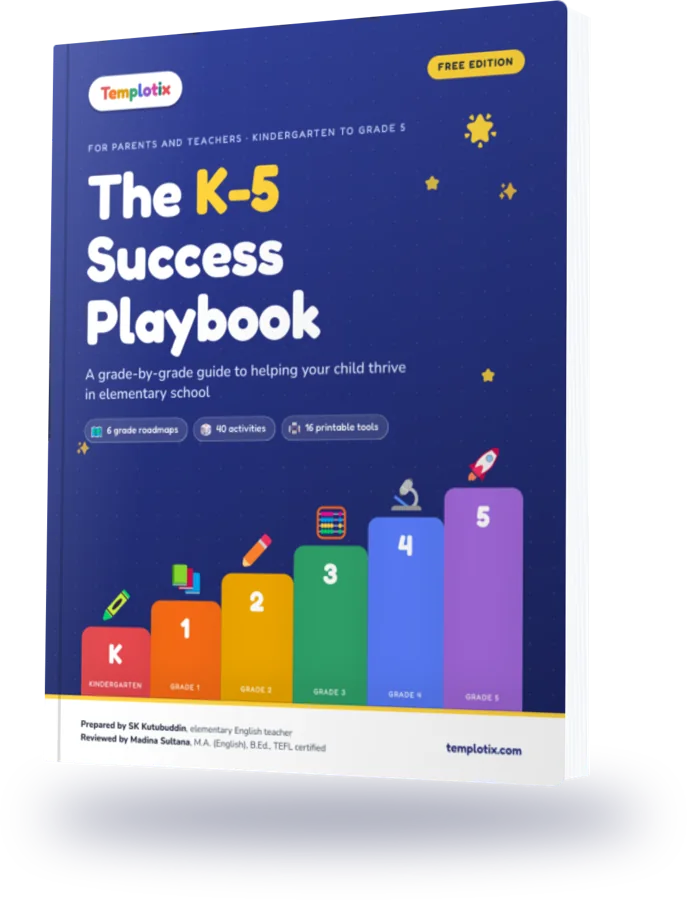
Helping a child at home? The K-5 Success Playbook is our free 82-page ebook, with a grade-by-grade guide for kindergarten to 5th grade.
Common questions
How do you explain a circuit to a child?
A circuit is like a running track for electricity. The battery is the starting line, the wires are the track and the bulb is a stop along the way. If the track has a gap, the runners stop and the bulb goes out.
What is the difference between a conductor and an insulator?
A conductor lets electricity flow through it, like copper wire, a paper clip or a key. An insulator stops it, like plastic, rubber, wood or glass.
What grade learns about electric circuits?
In the NGSS, 4th grade learns that energy can be carried from place to place by electric currents (4-PS3-2) and designs devices that change energy from one form to another (4-PS3-4), which often means building simple circuits.