Shop
 Grade workbooks


Classroom · Handwriting
worksheets
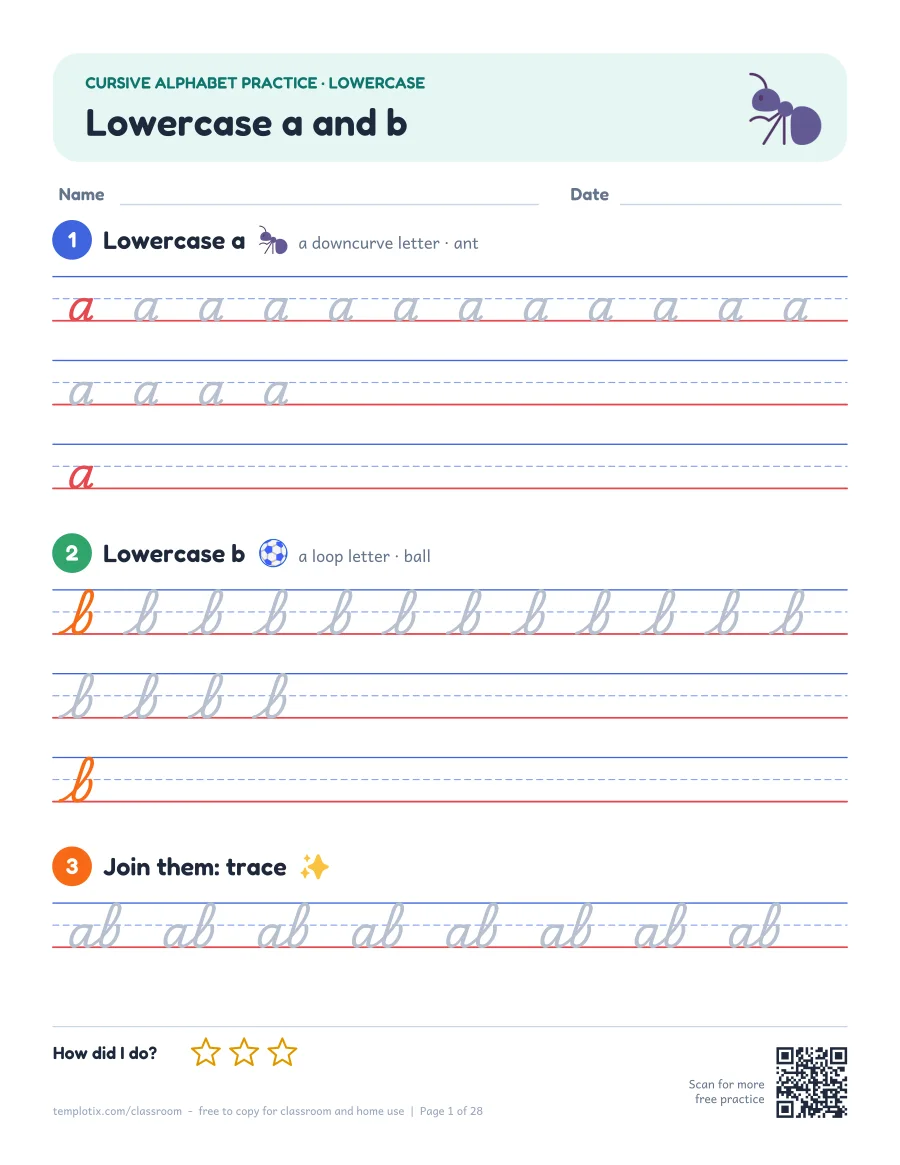
Every cursive letter, capital and lowercase, on proper handwriting lines. Start with the one-page alphabet chart, work through the A to Z practice book, or open any letter for step-by-step strokes and a three-page worksheet that ends with joined words.
Cursive alphabet chart
All 26 letters with pictures, for the wall or a desk.
A to Z practice book
Lowercase and capitals, the whole alphabet, and a certificate.
The cursive alphabet
Choose a letter for its strokes and worksheet.
- Aaant
- Bbball
- Cccat
- Ddduck
- Eeegg
- Fffish
- Gggoat
- Hhhat
- Iiice cream
- Jjjet
- Kkkite
- Lllion
- Mmmonkey
- Nnnest
- Oooctopus
- Pppenguin
- Qqquestion
- Rrrabbit
- Sssun
- Ttturtle
- Uuumbrella
- Vvvan
- Wwwhale
- Xxbox
- Yyyarn
- Zzzebra


Make your own cursive sheets
 Make your own cursive sheets
Type a name, this week’s spelling words or a sentence, and the cursive worksheet generator turns it into joined-up tracing practice on handwriting lines. Three practice styles, three sizes, color or ink saver.
Open the cursive worksheet generator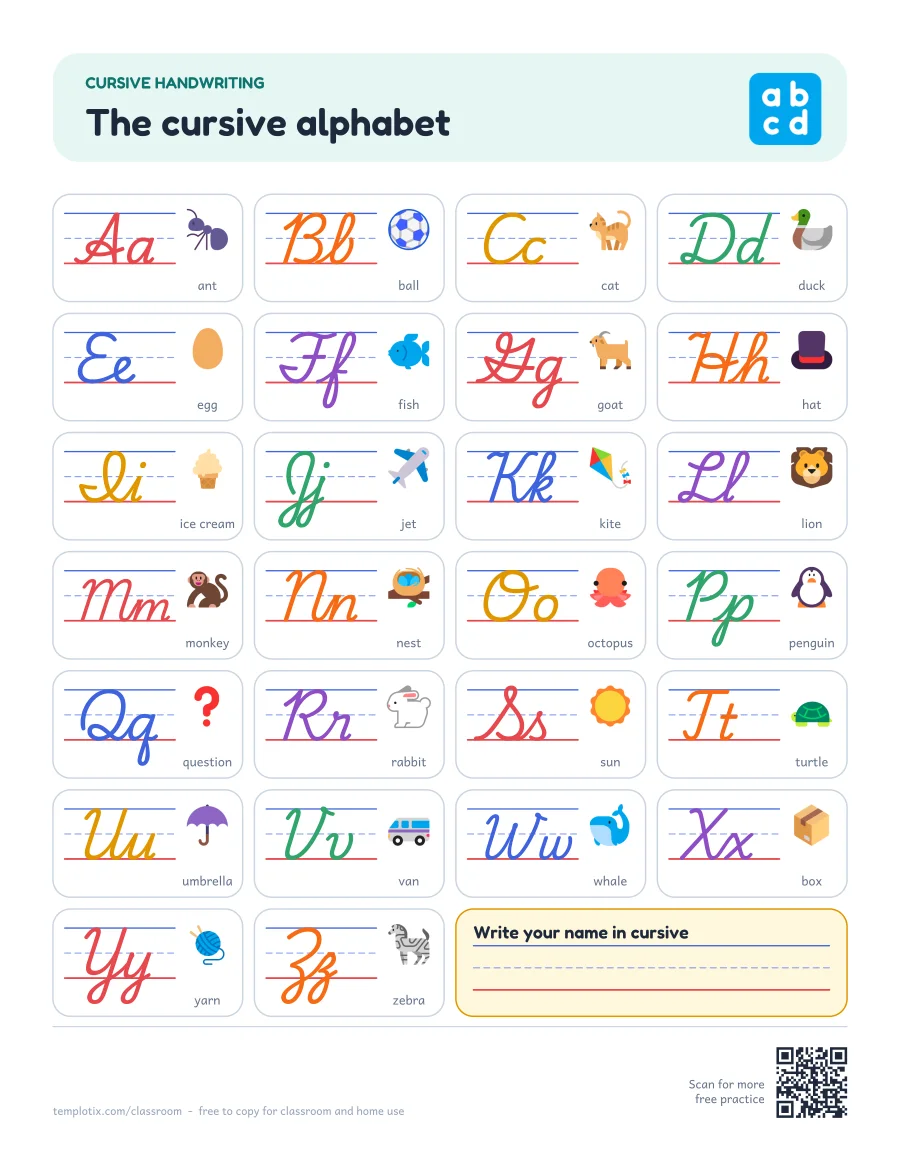
How to teach cursive, one family at a time
 How to teach cursive, one family at a time
Cursive letters fall into four families by the way they start. Teach a family together and each new letter is only a small change from the last one.
1. Undercurve letters
They join on with a swing up (an undercurve) from the baseline, then slide down.
2. Loop letters
They swing up from the baseline and make a loop before sliding down.
3. Downcurve letters
They start a little below the midline and curve back over the top, like the start of a c.
4. Overcurve letters
They begin with a hump (an overcurve) at the midline, like the start of an n.
- Air-write first. Say the strokes aloud while drawing the letter big in the air, then on the desk with a finger.
- Trace, then fade. Every worksheet row hands over from gray letters to trace, to a single model, to a blank line.
- Join early. As soon as two letters are known, join them. The join is the point of cursive.
- Little and often. Ten minutes a day builds the movement faster than one long session a week.
Common questions
At what age do children learn cursive?
Schools that teach cursive usually start in 2nd or 3rd grade, around ages 7 to 9, once a child prints letters easily. Starting earlier is fine at home if printing is already fluent; the letter shapes are the same either way.
Should children learn lowercase or capital cursive letters first?
Lowercase first. Lowercase letters make up almost everything we write, and they are where the joins happen. Capitals come next, starting with the ones children need for their own name.
In what order should the cursive letters be taught?
Teach letters that start the same way together. A common order is the undercurve letters (i, t, u, w, r, s, p, j), then the loop letters (e, l, h, k, f, b), then the downcurve letters (a, d, g, o, c, q) and finally the overcurve letters (n, m, x, y, v, z). Each group adds one new starting stroke.
Which cursive style do these worksheets use?
A traditional US school cursive with looped tall letters and tails. The letters are set in Playwrite US Trad, a free typeface made by TypeTogether for teaching handwriting, so every model letter is the same on every sheet.
Can I copy these worksheets for my class?
Yes. The PDFs are free to print and photocopy for classroom and home use, in color or in the black-and-white ink saver. Please link to this page rather than re-uploading the files.